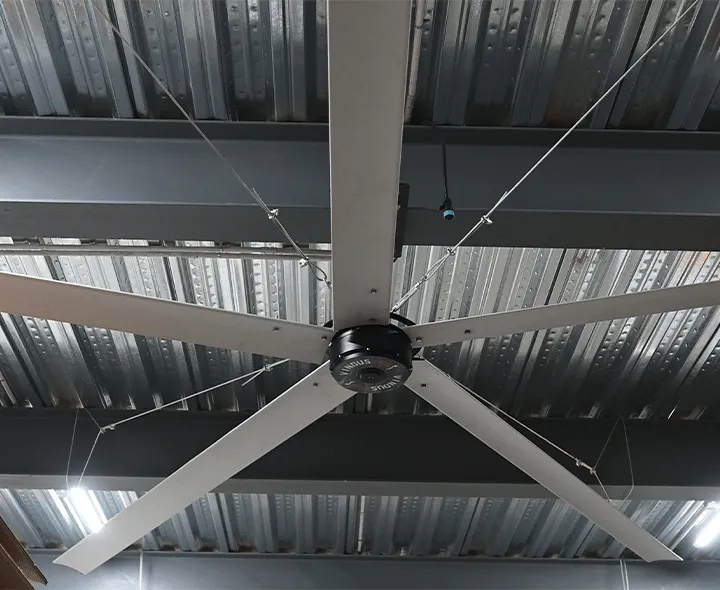
Choosing a large industrial ceiling fan is not simply about finding the biggest model or the lowest price. Every warehouse, factory, and industrial building has different airflow needs, ceiling structures, and operating conditions. The right system must match the building, equipment, and people working inside it.
In this guide, we explain how engineers evaluate HVLS technology, compare industrial fan designs, review motor and blade specifications, and assess long-term operating costs. You will also learn what to check when comparing manufacturers and selecting a reliable solution for large industrial projects.

Large Industrial HVLS Ceiling Fans for Warehouses: An Engineer’s Guide to Big Ceiling Fan Systems
Esquema del artículo
- Why Do Large Industrial Spaces Need an Engineered Ceiling Fan Strategy?
- What Makes an Industrial Ceiling Fan Different from a Standard Ceiling Fan?
- What Should an Engineer Measure Before Selecting a Big Ceiling Fan?
- How Do Fan Diameter, Blade Design, and Motor Technology Affect HVLS Performance?
- How Can an Industrial Fan Improve Energy Efficiency and Reduce Operating Costs?
- What Mounting and Structural Requirements Matter for Large Ceiling Fans?
- How Should Buyers Compare HVLS Fans on the Market?
- How Can Warehouse Fans Work with HVAC and Production Systems?
- What Should Engineers Check When Choosing an Industrial Ceiling Fan Manufacturer?
- How Can You Confirm That You Have Selected the Right Fan?
1. Why Do Large Industrial Spaces Need an Engineered Ceiling Fan Strategy?
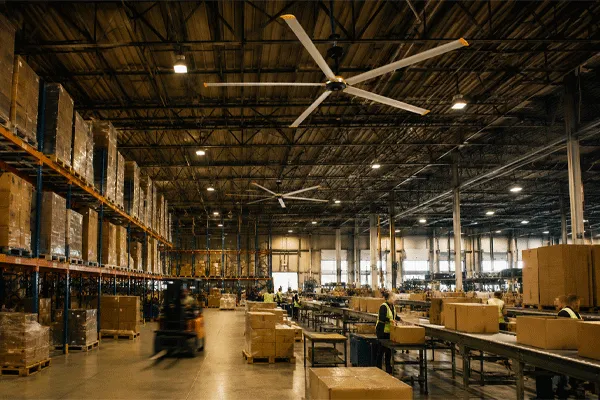
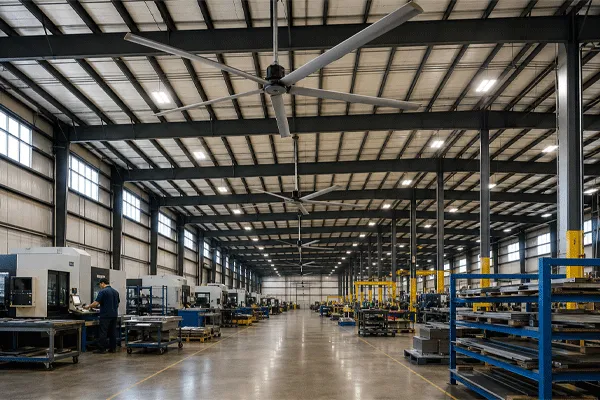
Large industrial buildings face airflow challenges that ordinary cooling equipment cannot always solve. A warehouse may have high storage racks, loading doors, and long aisles. Manufacturing facilities may contain heat-producing machines, production lines, and areas where employees work for extended periods. These conditions make air distribution more complicated.
A properly selected industrial ceiling fan helps move air across a wider area instead of concentrating cooling in one location. This is especially important in buildings with high ceilings, where warm air naturally collects near the roof. Without effective air circulation, workers at floor level may experience uncomfortable conditions even when the upper part of the building is much warmer.
At COOL Fans, we approach large industrial airflow projects from an engineering perspective. We consider building dimensions, operating schedules, motor performance, fan positioning, and control requirements before recommending equipment. Our goal is to provide a complete solution rather than simply sell a big ceiling fan.
Common Problems in Industrial Buildings
| Problem |
Possible Cause |
Engineering Consideration |
| Uneven temperatures |
Poor air mixing |
Fan layout and coverage |
| Hot working areas |
Process heat and limited air movement |
Local airflow requirements |
| Facturas energéticas elevadas |
Excessive HVAC operation |
Air circulation and control |
| Stagnant air |
Poor distribution |
Airflow planning |
| Temperature differences |
Warm air accumulation |
Desestratificación |
2. What Makes an Industrial Ceiling Fan Different from a Standard Ceiling Fan?
A standard ceiling fan is generally designed for a relatively small area, such as a bedroom, office, or shop. Its main purpose is to provide localized comfort. An industrial fan has a different job: it must move large amounts of air across a much wider area while operating reliably in demanding environments.
HVLS stands for High Volume Low Speed. These fans use large-diameter blades that rotate at relatively low speeds to distribute air over broad floor areas. Compared with multiple small fans, a properly designed HVLS system can provide more consistent air movement with fewer individual units.
The difference also involves construction. Industrial products require suitable motors, reinforced mounting arrangements, electrical protection, and control systems. Their blades must maintain stable performance during long operating periods. Durability is therefore an important factor when selecting equipment for manufacturing plants, distribution centers, and other industrial facilities.
| Característica |
Ventilador de techo estándar |
Ventilador industrial HVLS |
| Main application |
Homes and offices |
Warehouses and factories |
| Diámetro |
Relatively small |
Gran diámetro |
| Operating speed |
Generally higher |
Baja velocidad |
| Air distribution |
Localizado |
Wide-area |
| Motor requirements |
Residential duty |
Industrial-grade design |
| Instalación |
Ordinary ceiling support |
Engineered structural support |
| Controla |
Basic switches or remote |
Variable-speed and centralized options |
An industrial ceiling fan is not simply a larger residential product. Its entire design must suit the building and operating environment.
3. What Should an Engineer Measure Before Selecting a Big Ceiling Fan?
Before choosing a model, an engineer should understand the actual building conditions. Floor area alone cannot determine the correct fan size or quantity. Two warehouses with the same floor area may require different systems because their roof heights, storage layouts, and equipment arrangements are different.
The first measurement is ceiling height. It helps determine whether a particular diameter and installation arrangement are suitable. The engineer should also identify structural beams, lighting equipment, sprinklers, overhead cranes, ventilation ducts, and other obstructions.
Next, consider how the building operates. A warehouse with high storage racks may need a different layout from a manufacturing facility with open production lines. Employee working zones, loading areas, machinery, and frequently opened doors can all affect air movement.
Essential Project Information
Before requesting a quotation, prepare:
- Building length, width, and ceiling height.
- Roof structure and available mounting positions.
- Storage rack dimensions and aisle orientation.
- Production equipment and heat-producing areas.
- Existing HVAC and ventilation arrangements.
- Typical occupancy and operating hours.
- Electrical supply and control requirements.
- Indoor temperature and humidity conditions.
This information helps engineers determine the appropriate fan diameter, quantity, spacing, and installation configuration.
For example, a building with a clear roof structure may allow a different layout from one with multiple overhead cranes. A good design considers these details before equipment is ordered.
4. How Do Fan Diameter, Blade Design, and Motor Technology Affect HVLS Performance?
Three important components influence the performance of an HVLS fan: diameter, blade design, and motor technology.
Diámetro affects the overall airflow distribution area. Larger models are generally suitable for wider spaces, but selecting the largest available option is not always the best decision. The fan must match the ceiling height, mounting position, and surrounding equipment.
Blade design also matters. An aerodynamic blade helps the fan move air while controlling resistance and operating noise. Blade material, shape, thickness, and structural strength should be evaluated together. For industrial applications, blade stability and reliable connections are particularly important.
Motor technology determines how the equipment drives the blades and controls operating speed. COOL Fans uses PMSM direct-drive technology across its HVLS product range. This arrangement removes the need for traditional belt or gearbox transmission components and supports variable-speed operation.
COOL HVLS Product Selection
| Product Series |
Diameter Options |
Typical Installation Height |
| P680 |
8, 10, 12, 14 ft |
10–25 ft |
| P730 |
16, 18 ft |
20–33 ft |
| P780 |
20, 24 ft |
20–33 ft |
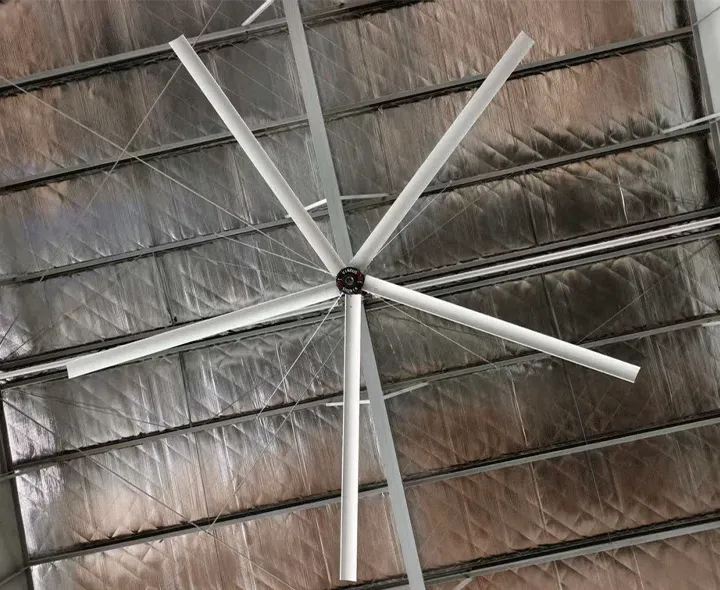
These three product families use five-blade configurations. Their different sizes allow buyers to consider solutions for medium-sized commercial buildings through to large industrial spaces.
For more product information, visit:
The correct selection should always be confirmed against the latest technical datasheet and project conditions.
5. How Can an Industrial Fan Improve Energy Efficiency and Reduce Operating Costs?
Energy efficiency is one of the main reasons businesses consider HVLS technology. However, buyers should look beyond the motor’s rated power. They should also consider the airflow delivered, operating hours, control strategy, maintenance needs, and interaction with existing cooling systems.
During summer, a large ceiling fan creates air movement across occupied areas. This increases the rate at which heat leaves the human body through evaporation, helping people feel cooler without necessarily lowering the actual room temperature.
During colder seasons, some HVLS systems can operate in reverse to help redistribute warm air trapped near the ceiling. This process, known as destratification, can support more balanced indoor temperatures and improve the use of existing heating equipment.
What Should Buyers Compare?
| Evaluation Item |
Por qué es importante |
| Rated power |
Indicates electrical input |
| Operating speed |
Helps match airflow to demand |
| Airflow performance |
Shows the amount of air moved |
| Motor technology |
Influences operating characteristics |
| Control functions |
Helps avoid unnecessary operation |
| Maintenance requirements |
Affects long-term ownership cost |
For a business, the real energy cost depends on how the complete system operates. A low-power fan is not automatically the most efficient choice if it cannot meet the project’s airflow requirements.
We recommend comparing measured performance data at different operating speeds rather than relying only on advertising claims. This provides a better basis for evaluating energy savings and long-term investment value.

Large Industrial HVLS Ceiling Fans for Warehouses: An Engineer’s Guide to Big Ceiling Fan Systems
6. What Mounting and Structural Requirements Matter for Large Ceiling Fans?
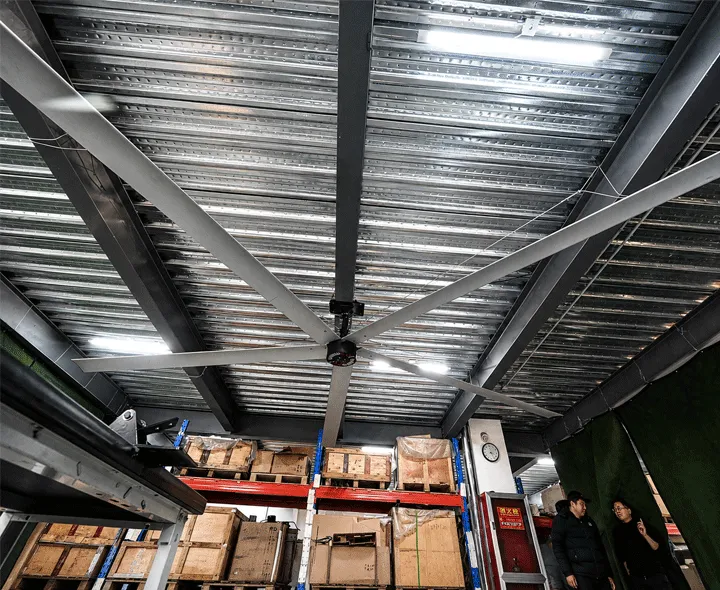
A large industrial fan places loads on the building structure. Its mounting arrangement must support the equipment weight and account for dynamic forces during operation. This is why installing industrial equipment requires coordination between the fan supplier, structural engineer, electrical contractor, and installation team.
The mounting location should be checked before the final model is selected. Roof beams, purlins, concrete structures, and other support elements have different load capacities. A decorative ceiling or suspended ceiling panel should not be treated as a structural mounting point without specific engineering approval.
Clearance is equally important. The blade path must avoid lighting equipment, sprinkler systems, cranes, ducts, and other overhead components. Maintenance access should also be considered so technicians can inspect the fan without unnecessary difficulty.
Structural and Installation Checklist
- Verify the supporting structure and load capacity.
- Confirm the approved mounting bracket and hardware.
- Review blade clearance and surrounding obstructions.
- Check secondary safety provisions.
- Coordinate electrical wiring and controller installation.
- Review local building and fire protection requirements.
- Complete inspection and commissioning before operation.
Electrical engineers play an important role in checking power supply, motor protection, control wiring, and system integration. A successful installation requires all these elements to work together.
7. How Should Buyers Compare HVLS Fans on the Market?
There are many HVLS fans on the market, and product descriptions can make different models appear similar. However, specifications, motor configurations, structural designs, control functions, and after-sales support may vary considerably.
Buyers may encounter manufacturers and brands such as Hunter Industrial and Refresh Fans when researching industrial products. Rather than choosing based on brand recognition alone, compare the technical documentation and project support each supplier can provide.
A Practical Supplier Comparison
| Evaluation Factor |
Questions to Ask |
| Motor technology |
Is it PMSM direct drive or another configuration? |
| Blade construction |
What material and aerodynamic design are used? |
| Diámetro del ventilador |
Are suitable sizes available for the building? |
| Performance data |
Are airflow and power figures documented? |
| Apoyo estructural |
Are mounting drawings available? |
| Controla |
Are variable-speed and centralized options supported? |
| Garantía |
What parts and services are covered? |
| Fabricación |
Does the supplier control production and quality inspection? |
| Customization |
Can the solution match project requirements? |
A fan advertised as 24 feet in diameter may look impressive, but diameter alone cannot establish performance. Buyers should also review motor specifications, blade construction, operating power, and installation requirements.
Be careful with marketing expressions such as “humongous fan builds” or claims of universal coverage. A serious supplier should explain how its products perform under actual project conditions.
At COOL Fans, we focus on product engineering, PMSM direct-drive technology, quality inspection, and application-specific airflow solutions. Our products are developed for commercial and industrial applications rather than decorative use.
8. How Can Warehouse Fans Work with HVAC and Production Systems?
HVLS fans should be considered part of a building’s wider environmental management strategy. They circulate existing indoor air, support temperature distribution, and improve occupant comfort. They do not independently provide outdoor fresh air or remove pollutants from the building.
In a warehouse, air circulation can help reduce stagnant areas between storage zones and improve comfort for workers moving through long aisles. In manufacturing plants, the design may need to account for process heat, equipment locations, and fixed workstations.
The relationship with the HVAC system is also important. A well-planned fan layout can help distribute conditioned air more evenly, potentially allowing facility managers to review temperature settings and operating schedules. However, actual energy savings depend on building conditions and should be measured rather than assumed.
Different Applications Require Different Strategies
| Solicitud |
Main Engineering Priority |
| Warehouses and manufacturing plants |
Broad and balanced air distribution |
| Distribution centers |
Worker comfort across storage and loading zones |
| Automotive facilities |
Air movement around service and production areas |
| Food processing |
Coordination with hygiene and ventilation requirements |
| Edificios agrícolas |
Humidity and environmental management |
| Edificios comerciales |
Occupant comfort and flexible controls |
Integrating smart technology into industrial airflow control can make the system more responsive to different operating conditions. Temperature sensors, scheduled operation, and independent zones help managers adjust equipment according to real demand.
The key is to coordinate fans, cooling systems, heating equipment, and ventilation rather than treating each component as a separate solution.
9. What Should Engineers Check When Choosing an Industrial Ceiling Fan Manufacturer?
A reliable manufacturer should provide more than a product catalogue. Engineering support, technical documentation, production quality, and after-sales service are all important when purchasing equipment for a large project.
First, review the supplier’s manufacturing capabilities. Ask about motor assembly, blade production, product testing, quality inspection, and component sourcing. These details help buyers understand how consistently the manufacturer can deliver equipment.
Second, request the documents required for project evaluation. Depending on the application and market, these may include technical datasheets, installation manuals, structural drawings, electrical diagrams, performance test reports, and applicable certification documents.
Third, assess communication and project support. A manufacturer should be able to review building drawings, understand the intended application, and discuss installation conditions before recommending a model.
Documents Worth Requesting
- Product technical datasheets.
- Motor and controller specifications.
- Blade and structural information.
- Installation and mounting drawings.
- Airflow and power performance reports.
- Applicable safety and compliance documents.
- Warranty terms and maintenance guidance.
- Spare-parts and after-sales support information.
Some projects also require specific color, mounting, or control configurations. A supplier with customization capabilities can help coordinate these requirements.
For large industrial projects, the value of a manufacturer lies not only in the equipment itself but also in its ability to support the complete project process.

Large Industrial HVLS Ceiling Fans for Warehouses: An Engineer’s Guide to Big Ceiling Fan Systems
10. How Can You Confirm That You Have Selected the Right Fan?
The final decision should be based on a complete evaluation, not a single specification. A suitable industrial fan must match the building dimensions, operating environment, airflow objectives, structural conditions, and budget.
Before placing an order, compare at least three aspects: technical suitability, installation feasibility, and long-term operating value. If any one of these is overlooked, the project may face unnecessary changes or disappointing performance.
After installation, the commissioning process should verify mounting security, electrical connections, control functions, operating stability, and clearance. Facility managers should also record operating settings and establish a regular inspection schedule.
Final Project Evaluation Checklist
| Item |
Confirmation |
| Building dimensions reviewed |
Yes / No |
| Fan diameter selected |
Yes / No |
| Motor and power specifications checked |
Yes / No |
| Blade configuration confirmed |
Yes / No |
| Mounting structure approved |
Yes / No |
| Electrical and control requirements reviewed |
Yes / No |
| Performance documentation received |
Yes / No |
| Installation and commissioning completed |
Yes / No |
| Maintenance plan established |
Yes / No |
A successful project is not defined by how large the equipment looks. It is defined by whether the system performs reliably, supports the working environment, and meets the facility’s long-term operating needs.
At COOL Fans, we work with distributors, HVAC contractors, factory owners, warehouse operators, and engineering teams to develop suitable HVLS solutions. Our product range includes the P680, P730, and P780 series, supported by intelligent airflow control options.
Whether you are planning a new building or upgrading an existing industrial facility, sharing your building dimensions, roof structure, and application requirements is a practical first step toward selecting the right system.
Puntos clave
- Choose according to engineering requirements: Building dimensions, ceiling height, and operating conditions matter more than fan diameter alone.
- Understand HVLS technology: Large blades operating at low speed provide broad air distribution for industrial applications.
- Compare complete specifications: Review motor technology, blade construction, power consumption, and measured airflow.
- Check structural requirements: Mounting arrangements and overhead clearances must be professionally assessed.
- Evaluate long-term costs: Consider operating hours, controls, maintenance, and HVAC interaction.
- Compare manufacturers carefully: Technical documentation, manufacturing capabilities, customization, and after-sales support all matter.
- Plan system integration: HVLS fans support indoor air circulation but do not replace mechanical ventilation or exhaust systems.
- Work with an experienced supplier: A manufacturer with engineering support can help turn building requirements into a practical airflow solution.
Looking for large industrial ceiling fans for your warehouse or manufacturing project? Contact COOL Fans to discuss your application, compare suitable HVLS models, and request an engineering-based product recommendation.