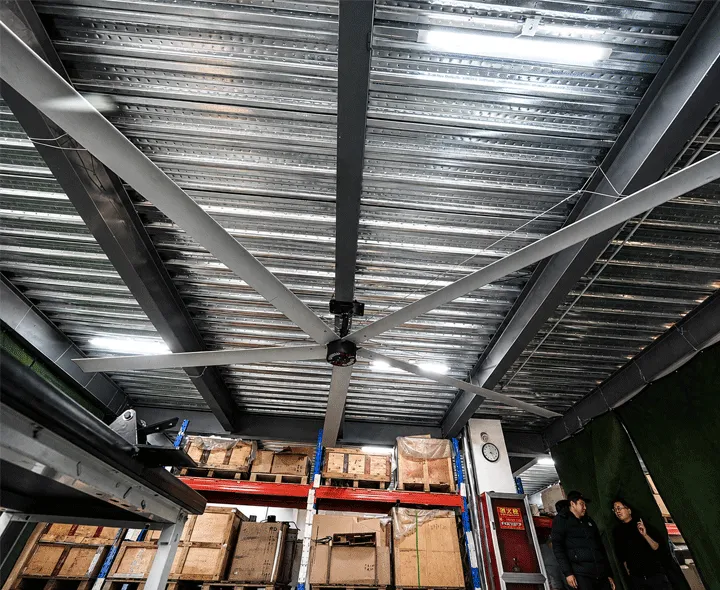
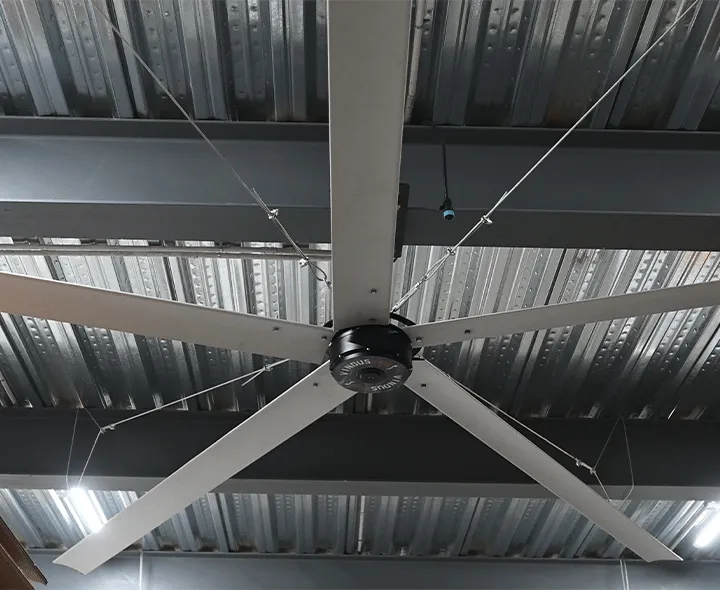
Hot spots, humidity swings, and soaring energy costs plague large facilities. Without steady air circulation, worker comfort drops and HVAC bills climb. A correctly sized industrial?HVLS ceiling fan fixes all three problems in one elegant, low?speed swoop.
A single?industrial HVLS fan (high-volume low-speed)conditions roughly 4?000–6?000?sq?ft per foot of diameter. Purchase and installation average $0.25?$0.32?per?sq?ft, yielding 12–18?month payback through lower HVAC run?times, reduced moisture, and happier staff.
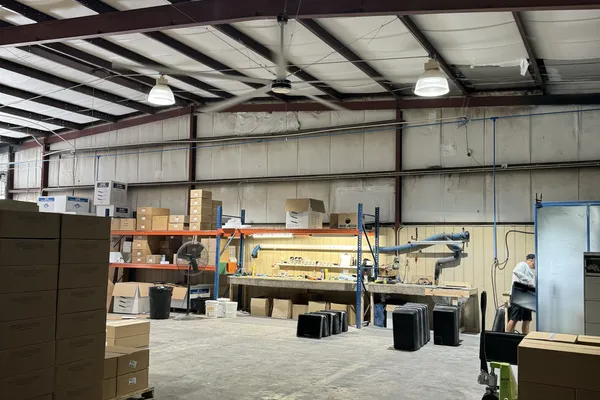
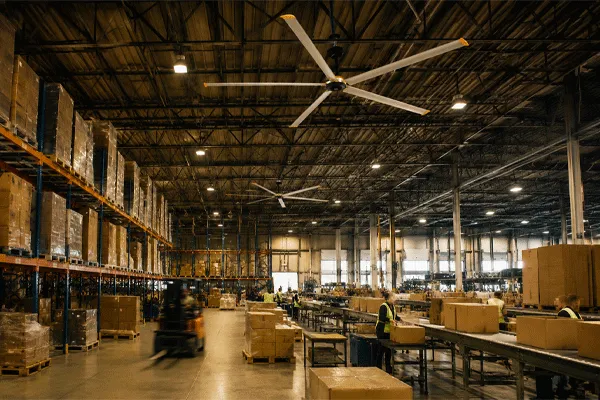
industrial hvls fan in warehouse
Article Outline
- What Is an HVLS Fan and Why Is It Different from a Standard Ceiling Fan?
- How High?Volume?Low?Speed Technology Improves Airflow in Industrial?Spaces
- Sq?Ft Coverage: How Many Feet in Diameter Equals How Much *Air Movement?
- Industrial HVLS Fan Cost per Square Foot – Crunching the Numbers
- Life?Cycle Cost vs. Portable and Traditional Fans – Value?of?HVLS
- Safety & Certification Checklist for Industrial Facilities
- Selecting the Right Fan Blade Size (8?to?24?Feet) for Warehouses and Gyms
- Installation Tips: From Distribution Centers to Large Commercial Showrooms
- Frequently Asked Questions – Buying Guide for Efficient HVLS
- Action Plan: 5 Steps to Specify a Dependable HVLS System
1. What Is an HVLS Fan and Why Is It Different from a Standard Ceiling Fan?
HVLS fans provide superior air movement because they spin slowly—usually ≤70?RPM—yet sweep a circle up to 24?feet in diameter. This generates a large, laminar column that descends, spreads out, and blankets the floor in cool, gentle breeze.
Quote from our senior engineer:
“Fans range from 8?to?24?ft and can replace dozens of high?speed floor fans while using just a quarter of the power.”
Table?1 – Quick Specs vs. Small Fans
| Metric |
HVLS Industrial Ceiling Fan |
Small 56″ Ceiling Fan |
| Diameter |
8?–?24?ft |
4?–?5?ft |
| Air Volume |
100?000?CFM |
10?000?CFM |
| Typical RPM |
<70 |
>300 |
| Noise |
45?dB |
65?dB |
| Annual kWh (24/7) |
1?500 |
5?200 |
Internal deep dive: M650 Series HVLS Fans – our best?selling low?speed fans for mid?height facilities.
2. How High?Volume?Low?Speed Technology Improves Airflow in Industrial Spaces
High Volume, Low Speed
The high volume low speed principle pushes large amounts of air at gentle velocity, eliminating stagnant air pockets in large industrial and commercial buildings.
Climate Control Synergy
Because the fans are mounted near the industrial ceiling, they mix warm and cool layers, cutting heating fuel by up to 30?% and cooling runtime by 25?%. In tests across distribution centers, set?points rose 3?°C with no comfort loss—pure energy savings.
HVLS fans are designed to complement—not fight—existing HVAC.
Need application ideas? Explore warehouse HVLS fans for pick?lines, packing zones, and cold?storage docks.
3. Sq?Ft Coverage: How Many Feet in Diameter Equals How Much Air?Movement?
Engineers use a simple rule: 1?ft of diameter ≈ 1?000?sq?ft effective coverage at 25?ft mounting height.
Table?2 – Coverage and Running Cost
| Fan Size (ft) |
Coverage (sq?ft) |
Power Draw (kW) |
Monthly Op?Cost (12?h/day, $0.12/kWh) |
| 8?ft |
8?000 |
0.40 |
$17 |
| 12?ft |
12?000 |
0.55 |
$24 |
| 18?ft |
18?000 |
0.70 |
$30 |
| 24?ft |
24?000 |
0.95 |
$41 |
A single HVLS unit often replaces 6–10 wall fans, freeing floor space and slashing maintenance.
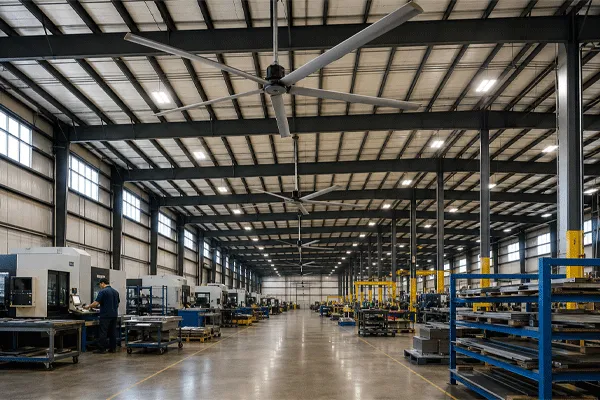
For manufacturing bays, see industrial ceiling fans for manufacturing—complete with CFD airflow maps.
4. Industrial HVLS Fan Cost per Square Foot – Crunching the Numbers
Step?by?Step Math
- Purchase price (20?ft model) …………… $3?900
- Mounting hardware + controls ………….. $850
- Electrical labor ……………………………… $600
- Total investment …………………….. $5?350
Divide by 16?000?sq?ft coverage → $0.334?per?sq?ft.
Value of HVLS: even premium eco?HVLS models stay below 35?cents per square foot—far cheaper than ducting upgrades or extra rooftop units.
ROI Bar?Chart
5. Life?Cycle Cost vs. Portable and Traditional Fans – Value?of?HVLS
| Cost Element |
Portable Floor Fans (25 units) |
Industrial?HVLS Fan (1 unit) |
| Capital Outlay |
$2?500 |
$5?350 |
| Annual Energy |
$4?100 |
$700 |
| 10?Year Parts |
$3?000 |
$1?200 |
| 10?Year Total |
$45?500 |
$12?350 |
Within 18?months, the value?of?HVLS becomes clear—cost savings exceed the initial premium, and facility managers gain quieter, safer aisles.
Want proof in a retail gym? Check the big commercial ceiling fans case study that details a 32?% HVAC reduction in a 28?000?sq?ft fitness center.
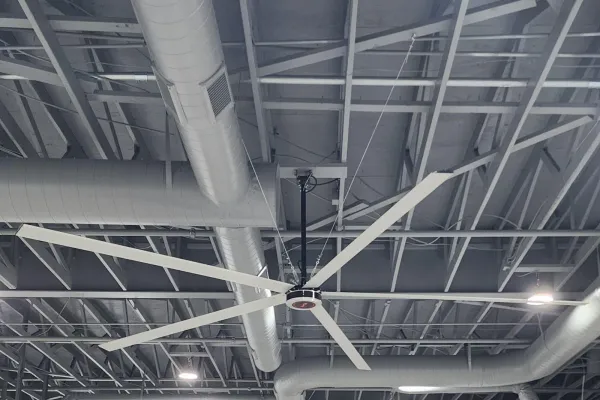
Value?of?HVLS
6. Safety & Certification Checklist for Industrial Facilities
Quick Stats
-
92?% of fire?marshals approve HVLS installs on first inspection
-
0.04?in/s vibration tolerance—the dependable?HVLS standard
-
24?feet?in?diameter fans weigh <140?kg thanks to aerospace alloys
| Requirement |
Why It Matters |
Our Compliance |
| UL?507 / CE |
Electrical & mechanical safety |
? All models |
| OSHA 1910.212 |
Guarding of rotating parts |
? Shrouded hub design |
| NFPA?13 |
Sprinkler clearance |
? Auto?stop at 149?°F |
| IEC?60730 |
Controller reliability |
? Redundant relays |
A single?HVLS that passes these tests is fit for industrial facilities, large commercial gyms, and even temperature?sensitive food plants. Add?on seismic kits anchor to concrete beams for hot and cold climates alike.
Expert quote – Hunter?Industrial field engineer:
“When fans range?from?8?to?24?ft, the hub?to?motor interface must be tested to 200?% load. Anything less risks premature fatigue.”
7. Selecting the Right Fan Blade Size for Warehouses, Gyms, and Large Commercial Spaces
Step?by?Step Buying Guide
-
Measure square footage and ceiling height. Remember: 1?ft diameter ≈?1?000?sq?ft effective coverage.
-
Map obstructions. Columns, cranes, or lights dictate whether you need two 14?ft units versus one 24?ft giant.
-
Check fan blade clearance—keep tips 2?ft from sprinklers.
-
Match controller to HVAC—our Modbus gateway links to any BMS for automated climate control.
-
Shop?HVLS?fans with sealed IP?55 drives for dusty industrial spaces.
Why Bigger Isn’t Always Better
-
8?Foot units excel in mezzanines and breakrooms.
-
14?18?ft models tame warehouse fans aisles without disrupting pallet flow.
-
Big ceiling 24?ft giants rule aircraft hangars and distribution hubs.
Need help sizing? Our design app shows square footage, velocity contours, and payback on one screen—one more reason HVLS fans deliver data?driven ROI.

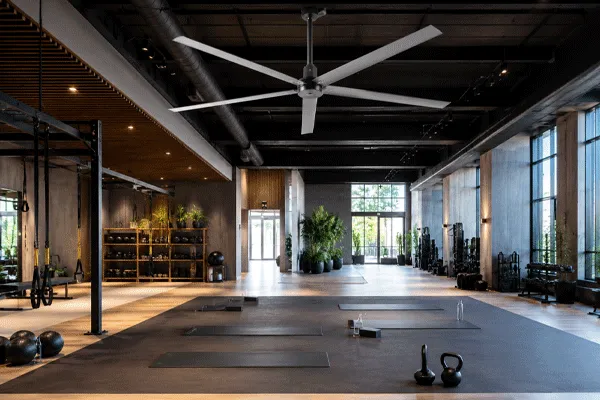
HVLS Fans in Commercial gym
8. Installation Tips: From Distribution Centers to Large Commercial Showrooms
Pre?Install Checklist
-
Engineers verify beam shear >2.5?kN.
-
Pull a dedicated breaker (3?×?480?V or 1?×?220?V).
-
Mount controller at eye level for easy 6?speed selection.
Commissioning Best Practices
-
Run at 50?% for 30?min; log amp draw—the baseline for energy?efficient audits.
-
Listen for wobble; <0.05?in/s ensures reduced energy consumption and improved bearing life.
-
Program winter reverse to gently push warm air down on December mornings.
Ventilation Synergy
Coupling fans with ridge vents evacuates fumes faster—critical in paint booths where air quality dictates finish consistency.
Explore turnkey installs on quiet fan for sport?center and big industrial fans for manufacturing.
9. Frequently Asked Questions – Efficient HVLS Buying Guide
How does an HVLS fan improve air circulation in large spaces?
: By creating a floor?level jet that spans 360°, replacing stagnant air with fresh breeze every 50?seconds.
Can HVLS fans operate with evaporative coolers?
: Yes. Combining the two boosts evaporative efficiency by 15?%, perfect for commercial spaces in dry regions.
What about noise in offices above the shop?
: At 45?dB, our fans are quieter than normal conversation—ideal for mezzanine conference rooms.
Do I need multiple controllers for multiple fans?
: One touchscreen can daisy?chain up to 30 units—fans are designed for network simplicity.
Will warranties cover abuse?
: Our 15?year industrial?HVLS warranty covers motors, drives, and fan blades against manufacturing defects.
10. Action Plan: 5 Steps to Specify a Dependable HVLS System
-
Schedule a free airflow model – We’ll overlay velocity maps on your CAD floor plan.
-
Select diameter & quantity – Options range?from?8?to?24?ft with color?matched hubs.
-
Approve quote – Transparent itemization shows value?of?HVLS vs. traditional fans.
-
Install & train – Certified crews mount, wire, and program in a single shift.
-
Track savings – Monthly report proves energy savings and comfort gains.
Ready to act?
Bullet?Point Summary
-
Industrial?HVLS fan cost per square foot averages $0.25?$0.35, with 12?18?month payback.
-
Correct sizing (8?–?24?ft) covers 8?000–24?000?sq?ft each, slashing energy costs.
-
Certifications (UL?507, CE) safeguard installs in industrial and commercial buildings.
-
Integrating with HVAC offers year?round efficient climate control—cool in July, warm in January.
-
Our turnkey approach delivers dependable HVLS performance, proven by case studies and 15?year warranties.
Transform your facility today—because comfort, cost?effective operations, and productivity should never be optional.