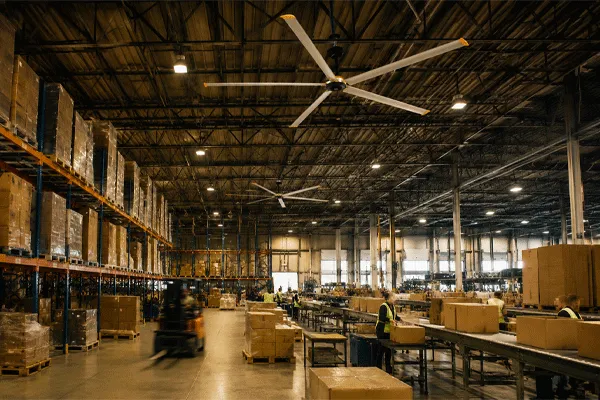
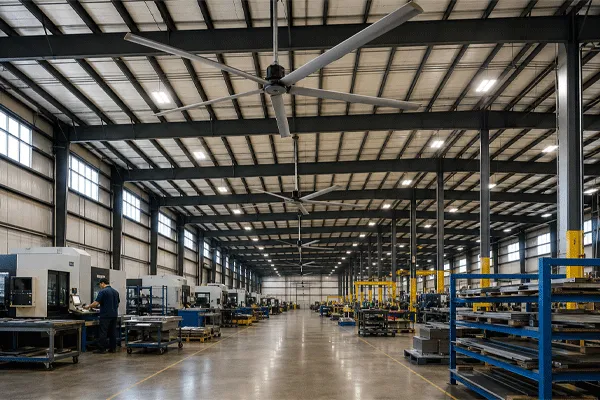
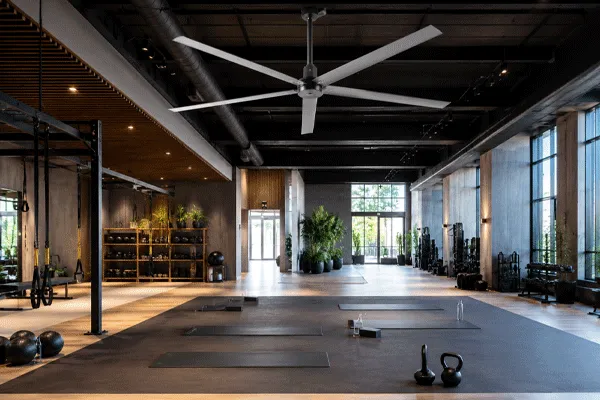
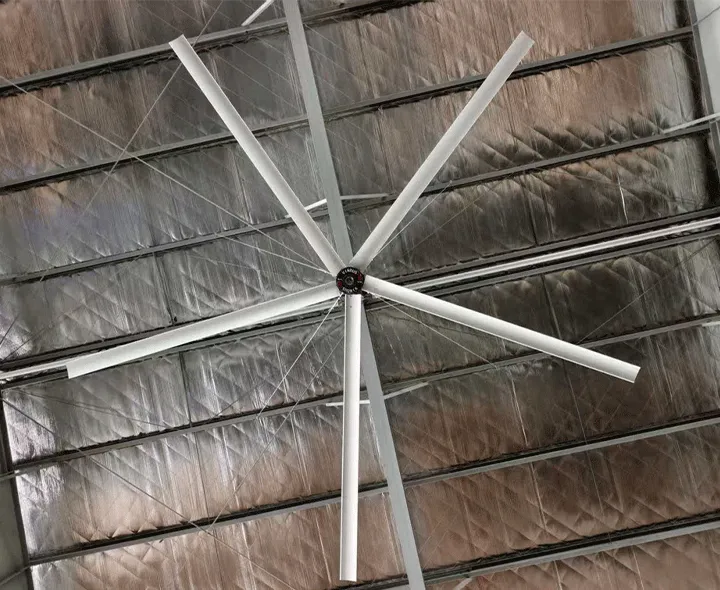
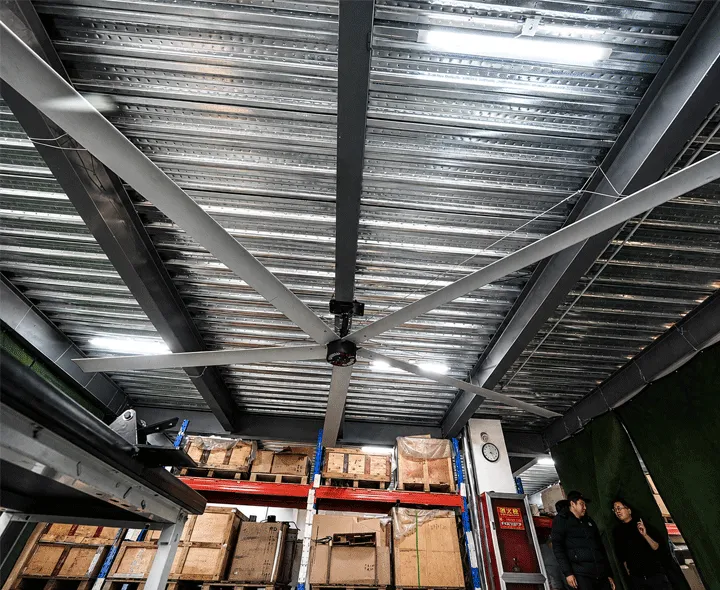
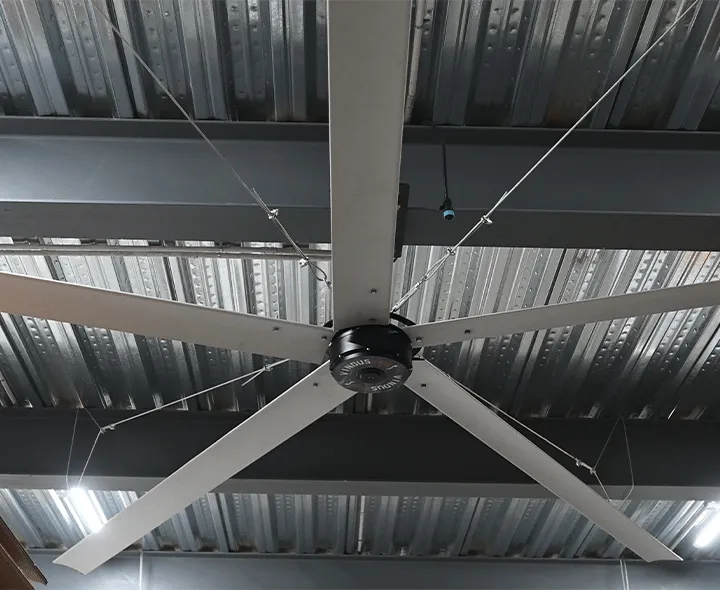
A hot warehouse can have plenty of fans and still feel uncomfortable. Why? Small fans often move air only in limited zones, leaving heat trapped above and dead spots below. An?HVLS fan solves a different problem: it moves a huge volume of air gently across a much larger space.
The main difference between an HVLS fan and a normal fan is airflow scale. An HVLS fan uses a large diameter and low rotational speed to move large volumes of air across wide industrial or commercial spaces. A normal fan usually runs faster but serves a smaller area. HVLS fans are better for warehouses, factories, gyms, logistics centers, and other high-ceiling spaces where broad, consistent air circulation is needed.
HVLS Fan vs Normal Fan: What Is the Difference Between HVLS Fans and Regular Ceiling Fans?
As a Sino-US joint venture manufacturer and airflow solution provider specializing in HVLS fans, industrial ceiling fans, commercial ceiling fans, and intelligent control systems, we often meet buyers who ask a simple question:
“Why install one large HVLS ceiling fan when I can buy several smaller fans?”
It is a fair question.
The answer has less to do with how powerful a motor looks and more to do with how air moves through a large building.
For warehouse owners, factory managers, HVAC contractors, logistics companies, agricultural operators, distributors, and commercial building developers, understanding this difference can prevent an expensive mistake.
What Is an HVLS Fan and How Is It Different From a Normal Fan?
HVLS means High Volume Low Speed.
An HVLS fan is a large-diameter ceiling fan designed to move a high volume of air at a low speed. In U.S. regulatory terminology, large-diameter ceiling fans are generally fans with a blade span of at least 7 ft, and commercial HVLS models can be much larger.
Unlike a normal fan, an HVLS fan does not try to create one narrow, high-speed blast.
It creates broad air movement.
A typical HVLS fan pushes a large column of air toward the floor. When that air reaches the floor, it spreads outward in all directions. Air then travels across a larger area before returning upward, creating continuous circulation.
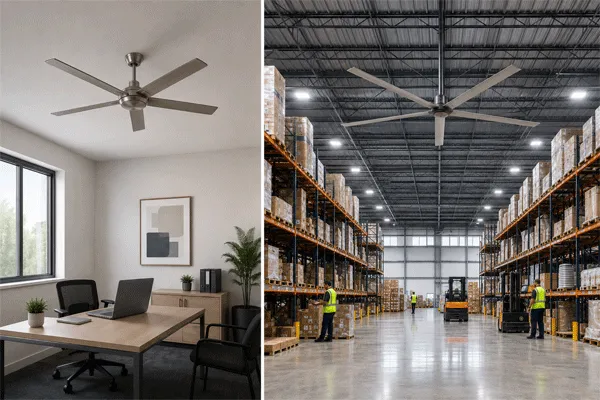
A normal fan works on a smaller scale. It may provide strong airflow directly in front of the fan, but the effect drops quickly with distance.
HVLS Fans and Normal Fans at a Glance
| Recurso |
Ventilador HVLS |
Normal Fan |
| Di?metro do ventilador |
Grande |
Small to medium |
| Operating speed |
Baixo |
Usually higher |
| Air volume |
Muito elevado |
Mais baixo |
| Cobertura |
Large area |
Local area |
| Air sensation |
Gentle, broad airflow |
Stronger local breeze |
| Best ceiling |
High ceiling |
Low or moderate ceiling |
| Typical use |
Warehouse, factory, gym |
Home, office, small shop |
| Number required |
Often fewer units |
Often multiple fans |
| Destratifica??o |
Strong capability |
Limitada |
| HVAC integration |
Very useful |
Limited by coverage |
The U.S. Department of Energy maintains specific test procedures and energy-efficiency requirements for ceiling fans, including large-diameter models.
For buyers comparing industrial equipment, our industrial ceiling fan solutions for warehouses and factories provide a useful starting point for understanding different fan sizes and configurations.
How Does an HVLS Fan Work in Large Spaces?
To understand how an HVLS fan works, think about a slow-moving wave instead of a narrow jet.
A large fan blade sweeps a much greater area with every revolution. Because the blade has a large diameter, it can move a large volume of air without spinning at the speed expected from a small fan.
The airflow moves downward as a broad air column.
When that column of air reaches the floor, it spreads horizontally through the occupied zone. This floor-level movement helps circulate air across a wide space.
That matters in buildings such as:
- Distribution centers
- Armazéns
- Instala??es de fabrico
- Aircraft hangars
- Sports halls
- Large retail spaces
- Edifícios agrícolas
A normal fan generally creates a smaller cone or stream of air.
That can work well if you only need to cool one workstation.
But if you need airflow across several thousand square feet, adding many smaller fans creates more equipment, more wiring, more maintenance points, and often less uniform coverage.
HVLS fans are designed around a different idea:
Do not make a small amount of air move very fast. Move a very large amount of air smoothly.
That is the foundation of high volume low speed fan technology.
HVLS Fan vs Normal Fan: What Is the Difference Between HVLS Fans and Regular Ceiling Fans?
Why Does a Large HVLS Fan Create Better Airflow Than Several Smaller Fans?
A fan does not cool air in the same way an air conditioner does.
Instead, moving air helps people lose heat through convection and evaporation.
ASHRAE Standard 55 recognizes air speed as one of the key environmental factors affecting human thermal comfort, together with temperature, humidity, and thermal radiation.
The advantage of an HVLS fan is coverage.
Imagine a large warehouse with workers spread across loading, packing, storage, and assembly zones.
Five small fans may produce five comfortable spots.
Between those spots?
Air may still feel stagnant.
A properly positioned single HVLS fan can create a much broader circulation pattern.
Simplified airflow pattern
Normal fan
Fan →→→ Strong local airflow
↓
Small coverage zone
Ventilador HVLS
         HVLS Fan
             ↓
         ↓ ↓ ↓
    ↓ ↓ ↓ ↓ ↓ ↓
← ← ← Broad floor airflow → → →
This wide pattern is one of the key differences between HVLS fans and traditional fans.
For facilities trying to solve heat buildup across large floor areas, our warehouse HVLS fan solutions focus on layout, coverage, ceiling height, and operational zones rather than simply adding more fans.
Do HVLS Fans Actually Cool a Warehouse or Factory?
Yes—but it is important to understand what “cool” means.
An HVLS fan does not normally lower the actual air temperature by several degrees on its own.
Instead, airflow across the human body increases heat loss and evaporation. That creates a cooling effect and can make workers feel more comfortable even when the measured room temperature has changed very little.
This distinction matters.
A fan is an air-moving device.
It is not a refrigeration system.
For a hot warehouse, factory, or gym, the goal may be to increase air speed in the occupied zone so workers feel cooler without requiring the HVAC system to do all the work.
ASHRAE’s thermal comfort framework specifically accounts for increased air movement when evaluating acceptable indoor conditions.
In practice, we usually ask facility managers:
- Where are people working?
- How high is the ceiling?
- Where does heat enter the building?
- Are large doors frequently open?
- Is mechanical cooling already installed?
- Are there racks or machines blocking airflow?
The right fan is not selected only by floor area.
The building itself determines performance.
Why Are HVLS Fans Better for High-Ceiling Buildings?
Heat naturally rises.
In a tall building, warm air can collect near the roof while cooler air stays near floor level. This creates temperature stratification.
During winter, that becomes especially wasteful.
The heating system warms the building, but a large amount of that heat may sit far above the people who need it.
ASHRAE guidance notes that high-volume, low-speed fans in high-ceiling areas are often used to improve air distribution and reduce temperature stratification.
An HVLS fan can mix those layers.
This is called destratification.
Without an HVLS fan
Roof
? Hot air
? Hot air
? Warm air
↓
Worker zone — cooler
With an HVLS fan
Roof
?
? Mixed air
?
Worker zone — more even temperature
The result is a more uniform vertical temperature profile.
This can help an HVAC system operate more effectively because conditioned air is distributed instead of remaining trapped near the ceiling.
During summer, the fan can operate faster to create more noticeable air movement.
During winter, it may operate at a lower speed to mix temperatures without creating an unwanted cold draft.
That seasonal flexibility is one reason industrial HVLS fans are useful year-round.
Are HVLS Fans More Energy Efficient Than Traditional Fans?
They can be, especially when the alternative is installing multiple fans across the same large area.
But energy efficiency should never be reduced to a marketing statement such as:
“One HVLS fan always saves X%.”
Every facility is different.
Energy results depend on:
- Fan motor efficiency
- Di?metro do ventilador
- Desenho da l?mina
- Operating speed
- Hours of operation
- Number of units
- HVAC equipment
- Heating and cooling setpoints
- Altura do teto
- Climate
- Building insulation
- Door-opening frequency
The basic advantage is scale.
One large fan may cover an area that would otherwise need many smaller commercial fans. Fewer motors can mean lower combined energy consumption, fewer control points, and less maintenance.
HVLS fans can also work with HVAC rather than against it.
During cooling seasons, higher air speed may allow occupants to remain comfortable under warmer thermostat conditions when the building design and comfort requirements permit.
During heating seasons, destratification can help bring unused ceiling heat back toward the occupied zone.
Research published in the ASHRAE Journal has examined this effect in high-bay buildings, including reduced floor-to-ceiling temperature gradients and reduced HVAC use through destratification.
For U.S. procurement, performance claims deserve careful review. DOE has mandatory test procedures and efficiency standards for covered ceiling fans, while AMCA recommends independently verified performance ratings when comparing large-diameter fans.
So when comparing fans, do not ask only:
“How many watts?”
Ask:
“How much useful airflow and coverage do I get from those watts?”
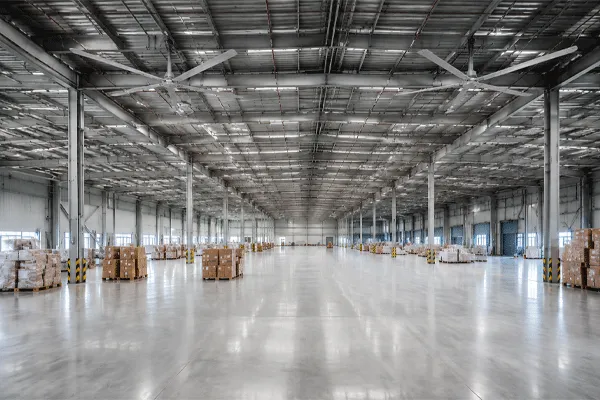
HVLS Fan vs Normal Fan: What Is the Difference Between HVLS Fans and Regular Ceiling Fans?
What Is the Difference Between HVLS Fans and Traditional Ceiling Fans?
A traditional ceiling fan and an HVLS ceiling fan share one basic idea: rotating blades create airflow.
Everything else happens at a different scale.
Ventiladores de teto tradicionais
A traditional ceiling fan works well for:
- Casas
- Restaurantes
- Small shops
- Offices
- Bedrooms
- Small commercial spaces
Its smaller blade diameter is appropriate because the room itself is smaller.
Ventiladores de teto HVLS
An HVLS fan is designed for large spaces such as:
- Armazéns
- Instala??es de fabrico
- Logistics facilities
- Aircraft hangars
- Large commercial spaces
- Sports centers
- Edifícios agrícolas
The purpose is not decoration.
The purpose is broad, controlled airflow.
A high volume low speed fan uses aerodynamic blade design, a large rotor diameter, and a suitable motor/control system to produce high airflow without the high rotational speed associated with smaller industrial fans.
That also affects sound.
A fast small fan often needs high blade tip speed to project air over distance. A larger fan can generate large volumes of air more gently.
For buyers comparing available configurations, our HVLS and industrial ceiling fan product range includes different diameter classes for small, medium, and very large industrial spaces.
When Is a Normal Fan Actually the Better Choice?
HVLS is not always the answer.
This matters.
A normal fan may be the better solution when you need localized directional airflow.
Examples include:
- A worker at one workstation
- A welding station
- A loading dock
- A narrow aisle
- A machine needing targeted airflow
- A low-ceiling room
- A small workshop
In these cases, a large ceiling fan may be unnecessary.
A compact wall-mounted, pedestal, mobile, or directional industrial fan can place airflow exactly where it is needed.
There is also a useful hybrid strategy.
Por exemplo:
HVLS fan = whole-space circulation
Directional fan = local problem area
A logistics center may use HVLS fans for broad circulation while using smaller fans around dock doors where workers experience intense heat during loading.
This is why a professional supplier should not try to sell the same fan to every customer.
We start with the airflow problem.
Then we select the equipment.
Where Do Industrial HVLS Fans Work Best?
The value of an industrial HVLS fan becomes clear in spaces where conventional air-conditioning alone is expensive or where broad air distribution is difficult.
Warehouses and logistics centers
High racks, loading doors, large floor plates, and tall ceilings create uneven airflow.
HVLS fans can help improve air circulation across storage, picking, and packing areas.
Nosso HVLS fans for warehouse cooling and ventilation are designed around these conditions.
Instala??es de fabrico
Machines, ovens, process equipment, lighting, and workers all add heat.
Factories often have multiple hot spots.
Broad air circulation can improve comfort without filling the facility with portable fans and cables.
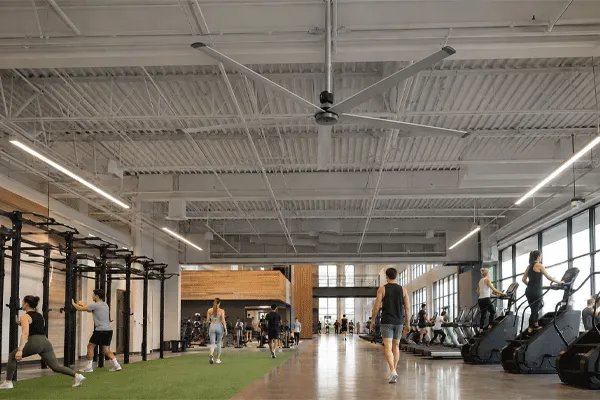
Gyms and sports centers
A gym requires strong but comfortable circulation across a wide occupied area.
The airflow should feel natural rather than like a high-speed industrial jet.
Large commercial spaces
Shopping centers, exhibition halls, terminals, and large retail spaces may use HVLS technology to complement conditioned air.
Agricultura
Greenhouses, livestock barns, and agricultural buildings need air circulation for different reasons.
The goal may involve:
- Animal comfort
- Heat-stress reduction
- Humidity management
- Floor drying
- Temperature distribution
KUUL’ agriculture and livestock airflow applications use fan selection based on animal zones, building dimensions, humidity, and seasonal conditions rather than applying a standard warehouse layout.
This is an important distinction.
A cattle barn and an electronics warehouse may use the same basic fan technology, but they should not automatically use the same airflow design.
Can an HVLS Fan Improve Indoor Air Quality?
An HVLS fan can improve air circulation, but it is important not to confuse circulation with ventilation.
A ceiling fan does not create oxygen.
It does not remove carbon dioxide.
It does not automatically remove dust, fumes, VOCs, smoke, or pathogens.
It moves air.
That movement can help distribute properly supplied fresh or conditioned air more evenly through a room and reduce stagnant zones. But if a factory needs contaminant removal, it may still require:
- Outdoor air ventilation
- Exaustores
- Local extraction
- Filtration
- Dust collection
- Make-up air
- Process ventilation
This distinction is especially important for food processing, welding, chemical operations, and dusty industrial environments.
We often tell project buyers:
Use an HVLS fan to improve air movement. Use a ventilation system to control air exchange and contaminants. Design them to work together.
That approach produces a much better result than expecting one piece of equipment to solve every air quality problem.
How Should HVLS Fan Installation Be Planned?
Good equipment can perform poorly when installed in the wrong place.
That is why HVLS fan installation should begin with the building layout.
Before selecting a fan, record:
- Building length and width
- Clear ceiling height
- Roof structure
- Beam locations
- Lighting
- Sprinklers
- HVAC ducts
- Cranes
- Racking
- Mezzanines
- Machinery
- Worker zones
- Large doors
- Electrical supply
Then identify the main goal.
Is it:
- Summer cooling?
- Winter destratification?
- Humidity management?
- General circulation?
- HVAC support?
- Worker comfort?
- All of these?
Fan placement affects the final consistent airflow pattern.
Two buildings with the same square footage may require completely different layouts because one has open floor space and the other has high pallet racks.
Fire protection must also be coordinated
HVLS fans installed in sprinkler-protected facilities require special attention.
NFPA 13 provisions for HVLS fans address fan diameter, placement relative to sprinklers, vertical clearance, and automatic fan shutdown during sprinkler system operation. FM Global research also found that automatic HVLS shutdown was important for maintaining sprinkler performance in the rack-storage fire tests it conducted.
This is why the fan should not be added after every other ceiling system has already been finalized.
Sprinklers, lighting, structural members, HVAC ducts, and fans should be coordinated together.
Our industrial HVLS fan systems and installation guidance treat the fan as a complete system that includes the mounting structure, motor, blades, controls, electrical connection, commissioning, and site layout.
How Do You Choose Between an HVLS Fan and a Normal Fan?
Use the building—not the catalog—to make the decision.
Start with five questions.
1. How large is the area?
For a small room, a normal fan is usually enough.
For a large commercial and industrial building, HVLS becomes more attractive.
2. How high is the ceiling?
A high ceiling creates greater opportunity for large-scale circulation and destratification.
3. Do you need local or whole-space airflow?
Choose a normal fan for a workstation.
Choose an HVLS fan when the whole zone needs circulation.
4. Are there major obstructions?
Racks, walls, mezzanines, machines, and storage can block the airflow pattern.
5. Is HVAC already installed?
If yes, the fan should be evaluated as part of the HVAC strategy.
Simple buying guide
| Situation |
Better Starting Choice |
| Small office |
Normal ceiling fan |
| Small workshop |
Normal/directional fan |
| Single work area |
Directional industrial fan |
| Large warehouse |
Ventilador HVLS |
| Manufacturing hall |
HVLS or hybrid system |
| Ginásio |
Ventilador HVLS |
| Distribution center |
Ventilador HVLS |
| Loading dock |
Directional fan or hybrid |
| Livestock barn |
HVLS/agriculture-specific design |
| Large retail hall |
Commercial HVLS fan |
A good fan manufacturer should also provide layout support.
Fan diameter alone does not tell you whether a product will work.
For international contractors, distributors, and project developers, our HVLS fan applications and airflow solution portfolio covers logistics, manufacturing, agriculture, sports facilities, automotive, warehouses, and commercial buildings.
Why Does Blade and Motor Design Matter?
A large fan is not simply a small fan made bigger.
Every major component affects performance.
The blade profile influences:
- Fluxo de ar
- Barulho
- Motor load
- Air distribution
- Vibra??o
- Eficiência
Blade width, twist, stiffness, angle, and aerodynamic profile all influence how smoothly the fan moves air.
The motor and drive matter too.
Different fan designs may use:
- Gear motors
- Motores de acionamento direto
- Permanent-magnet motors
- Variable-frequency controls
- Integrated electronic controls
But buyers should avoid choosing solely by motor type.
A premium motor connected to poor blades does not create a premium fan.
A strong fan system depends on:
Motor + blade + hub + structure + control + installation
The entire system must work together.
For large projects, intelligent controls can also coordinate operating schedules, speed levels, seasonal modes, and groups of fans.
This can be especially useful for multi-zone warehouses or manufacturing facilities where occupancy changes during the day.
What Should B2B Buyers Ask an HVLS Fan Manufacturer?
A project buyer needs more than a price.
Before purchasing, ask:
- What diameter do you recommend for my building?
- What usable coverage can I expect?
- What is the tested airflow performance in cubic feet per minute or equivalent units?
- What is the motor input power?
- What performance testing supports the data?
- What mounting structure is required?
- How does the fan coordinate with sprinklers?
- How much clearance is needed around the blade?
- Can you provide a fan layout?
- What controls are available?
- Is group control supported?
- What installation documents are included?
- What spare parts are available?
- What export documents can you provide?
- Can you support OEM or distributor projects?
This last point matters for global B2B buyers.
Distributors often need more than one shipment.
They need stable specifications, repeatable quality, technical documentation, installation support, branding options, and long-term spare-parts availability.
As a Sino-US joint venture manufacturer and solution provider, we approach HVLS projects as engineering work rather than simple fan sales. Our manufacturing and technical teams support product selection, airflow planning, control options, installation guidance, and international supply.
For brand owners and distributors, OEM HVLS ceiling fan manufacturing and customization can also support private-label product development and market-specific configurations.
FAQs About HVLS Fans vs Normal Fans
Is an HVLS fan better than a normal fan?
An HVLS fan is better for large spaces that require broad air circulation. A normal fan can be better for small rooms or local cooling. The best option depends on the size, ceiling height, airflow goal, and building layout.
Why does an HVLS fan spin so slowly?
Its large blade diameter moves a large volume of air with each revolution. The fan therefore does not need the high rotational speed used by many smaller fans.
Can one HVLS fan replace multiple smaller fans?
In many large open spaces, one properly selected HVLS fan can cover an area that would require multiple smaller fans. However, the actual number depends on ceiling height, obstructions, layout, fan performance, and required air speed.
Does an HVLS fan lower room temperature?
Not in the same way an air conditioner does. An HVLS fan mainly increases air speed and improves air mixing. This creates a cooling sensation for people and can help distribute conditioned air more effectively.
Can an HVLS fan work with air conditioning?
Yes. HVLS fans can complement an HVAC system by distributing conditioned air, increasing air movement, and reducing temperature stratification. The exact control strategy should be designed for the building.
Os ventiladores HVLS s?o apenas para armazéns?
No. They are used in factories, logistics centers, gyms, sports halls, shopping centers, agricultural buildings, livestock barns, automotive facilities, public buildings, and other large commercial and industrial spaces.