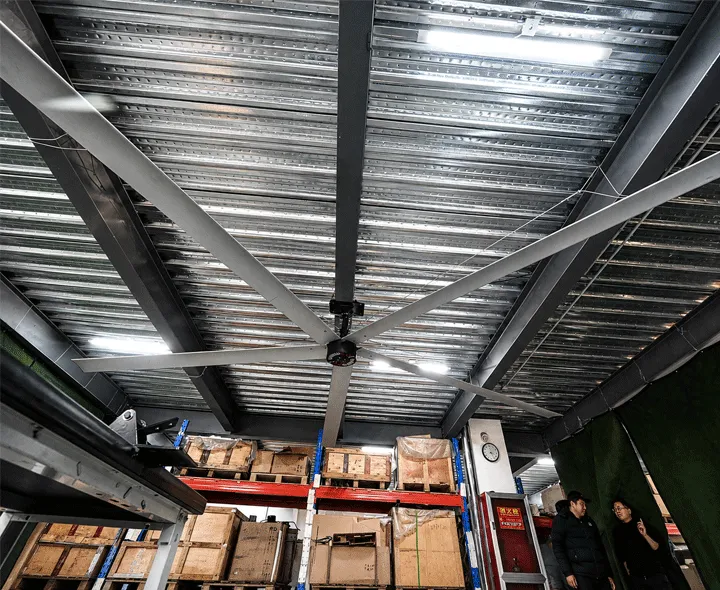
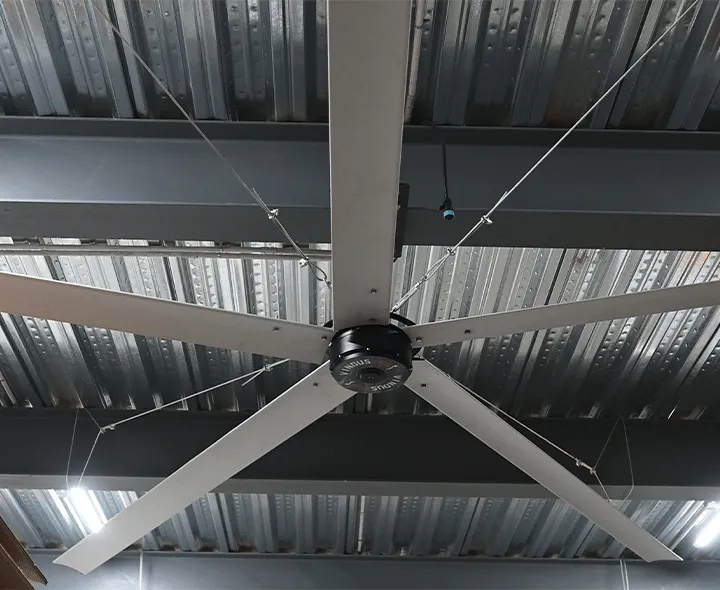
Sports halls, arenas, and event venues often struggle with uneven temperatures, high humidity, and poor air movement. When hundreds or thousands of people gather, these problems become harder to manage. Choosing the wrong fan can waste energy, create uncomfortable drafts, and interfere with activities.
Heavy-duty commercial and industrial ceiling fans help sports and event venues maintain more even air movement across large spaces. The right system depends on ceiling height, venue layout, occupant density, airflow requirements, structural loading, and operating conditions. For covered outdoor venues, environmental protection and mounting design also matter.

Heavy-Duty Commercial and Industrial Ceiling Fans for Sports and Event Venues: Outdoor Ceiling Fan Selection Guide
Whether you manage an indoor sports center, basketball arena, exhibition hall, or covered outdoor event space, this guide explains how to select, position, and operate the right HVLS fan system.
Plan de l'article
- Why Do Sports and Event Venues Need Heavy-Duty Ceiling Fans?
- How Should You Assess Each Room and Activity Zone?
- What Is the Recommended Room Size for a Large Ceiling Fan?
- How Should You Evaluate Airflow and CFM Requirements?
- What Loading Recommendations Should You Check Before Installation?
- How Do You Select the Right Downrod Length?
- When Should You Choose an Outdoor Ceiling Fan?
- How Can You Position Fans Around Lights, Vents, and Sports Equipment?
- Which Fan Controls Work Best for Sports and Event Venues?
- How Do You Compare Commercial and Industrial Ceiling Fans?
1. Why Do Sports and Event Venues Need Heavy-Duty Ceiling Fans?
Sports and event venues have different environmental demands from ordinary buildings. A basketball court, fitness center, swimming pool, and exhibition hall may all have large open floor areas, but their airflow needs are not the same.
Physical activity produces body heat and moisture. Large audiences also increase the indoor heat load. During busy events, poor air movement can make seating areas, courts, and spectator zones feel uncomfortable.
Heavy-duty HVLS fans address these problems by moving large volumes of air at low rotational speeds. Instead of creating strong, concentrated wind from a small unit, they distribute air across a wider floor area.
Main Benefits for Sports Facilities
- Better occupant comfort: Gentle air movement helps people release body heat through evaporation.
- More even temperatures: Air circulation helps reduce temperature differences between upper and lower areas.
- Humidity management: Moving air helps reduce stagnant, damp conditions, although it does not replace dehumidification.
- Energy efficiency: Fans can support existing HVAC systems and improve the distribution of conditioned air.
- Year-round operation: Forward operation supports summer comfort, while appropriate winter operation helps destratify warm air.
For example, a large basketball arena may experience high heat levels during tournaments but much lower occupancy during training sessions. Adjustable fan speeds allow facility managers to respond to these changes.
COOL Fans develops PMSM direct-drive HVLS systems for large industrial and commercial spaces, with options suited to sports halls, gymnasiums, and other public facilities.
2. How Should You Assess Each Room and Activity Zone?
Before choosing a fan, divide the building into functional zones. Measuring the total floor area alone is not enough.
A sports complex may contain several different environments:
| Venue Zone |
Main Airflow Requirement |
Important Consideration |
| Basketball courts |
Broad and even air movement |
Avoid distracting players |
| Indoor tennis courts |
Controlled air circulation |
Consider ball movement |
| Fitness and training areas |
Higher occupant-level air movement |
Manage heat and humidity |
| Swimming pool areas |
Moisture-aware air circulation |
Check corrosion resistance |
| Spectator seating |
Gentle and consistent airflow |
Avoid uncomfortable drafts |
| Exhibition halls |
Flexible airflow distribution |
Account for temporary layouts |
| Event stages |
Controlled occupant comfort |
Avoid disturbing curtains and stage equipment |
The activity taking place is just as important as the building dimensions.
For example, a fitness area can benefit from stronger air movement because users generate significant body heat. A badminton court may require more careful speed adjustment because excessive air movement can affect shuttlecock flight.
What Measurements Should You Collect?
Before requesting a quotation, prepare the following information:
- Building length and width.
- Floor-to-ceiling height.
- Height of the lowest structural obstruction.
- Position of lighting, sprinkler systems, and ventilation ducts.
- Location of sports equipment and retractable seating.
- Typical occupancy and event schedules.
- Existing HVAC and ventilation arrangements.
A simple building drawing can help an engineering team identify suitable fan positions and avoid unnecessary installation changes.
3. What Is the Recommended Room Size for a Large Ceiling Fan?
The recommended room size depends on more than square footage. Ceiling height, building volume, fan diameter, occupied areas, and obstructions all affect the final selection.
A large arena with a high roof may need fewer, larger-diameter HVLS fans. A smaller training hall with a lower ceiling may require compact models or several independently controlled units.
COOL HVLS Fan Selection Reference
The following table summarizes relevant product specifications for sports and event facilities.
| Fan Series |
Diamètre |
Recommended Blade Height |
Typical Spacing |
Maximum Power |
| P680 |
8–14 ft |
10–25 ft |
20–70 ft, depending on model |
100–290 W |
| P730 |
16–18 ft |
20–33 ft |
50–90 ft, depending on model |
450–460 W |
| P780 |
20 à 24 pieds |
20–33 ft |
60–120 ft, depending on model |
560–950 W |
These figures are preliminary product-selection references, not guaranteed coverage dimensions. Final spacing should follow a project-specific airflow and structural assessment.
Which Model Fits Different Sports Venues?
P680 Series
The P680 is suitable for medium-sized spaces, including fitness studios, training areas, and smaller sports facilities. Its 8–14 ft diameter range provides more flexibility where ceiling height or available mounting space is limited.
P730 Series
The P730 is a suitable option for larger gymnasiums, indoor courts, and field houses. Its 16 ft and 18 ft configurations are designed for ceiling heights between 20 and 33 ft.
P780 Series
The P780 is intended for larger spaces requiring wide-area air circulation. Its 20 ft and 24 ft configurations can suit large sports arenas, exhibition halls, and high-ceiling event facilities.
Explore the P680 Series HVLS fans, P730 Series HVLS fans, et P780 Series HVLS fans to compare their configurations.
4. How Should You Evaluate Airflow and CFM Requirements?
CFM means cubic feet per minute. It describes the volume of air a fan moves over a period of time and is commonly used when comparing air-moving equipment.
However, a higher CFM number does not automatically mean a better result for every sports facility.
The goal is to create useful air movement where people actually stand, sit, train, or compete. A powerful fan installed in the wrong position may create uneven airflow, while a properly designed system can distribute air more effectively across occupied areas.
What Should You Check When Comparing CFM?
Consider these factors:
- Measured performance: Request airflow figures supported by an identified test method.
- Operating speed: Compare performance at the speeds you expect to use, not only maximum speed.
- Air distribution: Understand how air moves from the fan toward the occupied zone.
- Fan spacing: Check whether adjacent fans create balanced circulation.
- Obstructions: Consider roof structures, lighting equipment, and seating arrangements.
For professional HVLS projects, AMCA 230-15 and ANSI/ASHRAE 216P are relevant performance-testing references. Ask suppliers to identify the applicable test method and provide comparable performance information.
COOL does not publish a fixed rated CFM figure for every model on its public product pages. Project-specific performance information should therefore be requested during quotation rather than estimated from fan diameter alone.
Another important point: HVLS fans circulate existing indoor air. They do not independently provide fresh outdoor air or remove pollutants. A complete facility design may still require mechanical ventilation, exhaust equipment, and appropriate HVAC systems.
For more technical information, see the HVLS fan airflow optimization guide.

Heavy-Duty Commercial and Industrial Ceiling Fans for Sports and Event Venues: Outdoor Ceiling Fan Selection Guide
5. What Loading Recommendations Should You Check Before Installation?
Structural support is one of the most important parts of installing a heavy-duty ceiling fan.
Large fans create both static and dynamic loads. The mounting structure must support the equipment weight and account for the forces generated during rotation and operation.
A suspended ceiling or decorative ceiling panel should never be treated as the primary support structure unless it has been specifically engineered for that purpose.
What Should Engineers Review?
Before installation, confirm:
- Roof beam and structural support capacity.
- Fan weight and mounting arrangement.
- Dynamic forces during operation.
- Vibration and potential structural movement.
- Safety cable and secondary retention arrangements.
- Clearance from lighting, sprinkler heads, and other equipment.
- Access for inspection and maintenance.
For reference, the published P730 product specifications list weights of approximately 179–188 lb, while P780 models weigh approximately 246–257 lb.
These figures show why professional structural assessment matters. The mounting design must account for more than the fan’s static weight.
Why Is Installation Quality Important?
A correctly selected fan can still create problems if the support structure, mounting hardware, or electrical connections are unsuitable.
For sports venues, installation planning should also consider the building’s operational schedule. Installing equipment during a planned maintenance period can reduce disruption to tournaments, training sessions, and public events.
Always follow the manufacturer’s installation instructions and applicable local building and electrical requirements.
6. How Do You Select the Right Downrod Length?
The downrod connects the fan assembly to its ceiling mounting point. Its length affects the final blade position and therefore influences how effectively the fan moves air through the occupied space.
A fan mounted too close to the roof may not distribute air as intended. A fan mounted too low may conflict with equipment, lighting, or required clearance zones.
What Determines the Correct Downrod Length?
Three measurements are especially important:
- Ceiling height at the mounting location.
- Distance from the ceiling support to the required blade height.
- Clearance from the lowest nearby obstruction.
For example, a sports arena may have roof trusses at 35 ft, but the lowest lighting equipment may hang at 29 ft. The installation team should use the actual available clearance rather than the roof height alone.
The published recommended blade height for COOL P730 and P780 models is 20–33 ft, while the P680 range is 10–25 ft.
These are installation-height ranges, not universal downrod dimensions. The correct downrod length must be determined from the actual mounting arrangement.
A Practical Installation Checklist
Before finalizing the downrod specification:
- Confirm the fan’s blade plane.
- Check the lowest structural and mechanical obstruction.
- Review sports equipment movement and retractable systems.
- Confirm the required safety clearances.
- Verify the mounting configuration with the manufacturer.
Do not select a longer extension simply because the building has a high ceiling. The objective is to place the fan at the correct operating height while maintaining safe clearance.
7. When Should You Choose an Outdoor Ceiling Fan?
Not every sports and event venue is fully enclosed. Many facilities include covered swimming pools, outdoor basketball courts, stadium concourses, open-air fitness areas, and semi-open event spaces.
These locations require additional attention to environmental exposure.
An outdoor ceiling fan should be selected according to the actual installation conditions, not simply because its product description contains the word outdoor.
What Environmental Factors Matter?
Moisture exposure
Covered outdoor spaces may experience high humidity, condensation, and occasional water exposure. Check the equipment’s ingress protection rating and approved installation conditions.
Corrosion resistance
Coastal sports facilities and swimming pool environments can expose equipment to salt or chemical-related corrosion. Confirm the suitability of materials, fasteners, and electrical components.
Temperature changes
Outdoor installations may experience wider temperature variations than indoor facilities. Check the manufacturer’s permitted operating temperature range.
Wind and mounting conditions
Open-sided structures may introduce additional wind loads and installation challenges. The supporting structure and mounting arrangement must be assessed accordingly.
The COOL P680 product range is positioned for applications that include outdoor patios and carries an IP55 rating. However, this should not be interpreted as unrestricted approval for direct rain, salt spray, or every exposed environment.
For projects with significant environmental exposure, request written confirmation of the model’s suitability before purchase.
8. How Can You Position Fans Around Lights, Vents, and Sports Equipment?
Fan placement is not simply a matter of distributing units evenly across a floor plan.
Sports and event venues often contain equipment that moves, changes position, or requires unobstructed space.
Common examples include:
- Basketball hoops and retractable backboards.
- Scoreboards and suspended display screens.
- Stage lighting and audio equipment.
- Sprinkler systems and ventilation ducts.
- Retractable seating and movable partitions.
- Exhibition banners and temporary rigging.
A fan layout should consider both permanent and temporary building arrangements.
Why Should You Use a Coordinated Layout?
Imagine a multipurpose arena that hosts basketball games during the week and exhibitions at weekends.
The basketball configuration may include raised hoops, scoreboards, and spectator seating. An exhibition configuration may introduce temporary booths, suspended banners, and different pedestrian routes.
If fan positions are planned only around the permanent court layout, later events may reveal conflicts.
A coordinated layout helps facility managers:
- Identify safe mounting locations.
- Avoid interference with sports and event equipment.
- Maintain useful air distribution across occupied zones.
- Plan independent control areas.
- Reduce future installation changes.
It is also important to coordinate fan locations with HVAC supply and return systems. Fans should support the building’s air distribution strategy rather than disrupt it.
9. Which Fan Controls Work Best for Sports and Event Venues?
Sports facilities rarely operate under one fixed set of conditions.
A gym may be busy in the morning, quiet in the afternoon, and crowded during an evening tournament. An exhibition hall may need different operating settings for setup, public access, and equipment removal.
Flexible controls help facility managers adjust operation without changing the physical installation.
Important Control Functions
| Control Function |
Practical Benefit |
| Variable speed |
Adjusts air movement to occupancy |
| Forward and reverse operation |
Supports seasonal airflow strategies |
| Scheduled operation |
Matches fan use to venue hours |
| Group control |
Allows different areas to operate independently |
| Temperature-based control |
Responds to changing indoor conditions |
| Building management integration |
Supports coordinated facility operation |
A remote control may be useful for basic equipment, but large venues often benefit more from centralized controls and clearly defined operating zones.
How Does Intelligent Control Improve Operation?
The COOL FanBrain system provides centralized HVLS fan management through a touchscreen interface. Its published features include:
- ON/OFF and speed adjustment.
- Forward and reverse operation.
- Scheduled operation.
- Temperature sensor integration.
- Group control by area.
- Modbus-RTU communication and BMS integration.
The published FanBrain configuration supports centralized control of up to 10 fans from one touchscreen. Actual system capacity and compatibility should be confirmed for the selected equipment configuration.
For a multipurpose sports venue, this allows facility managers to manage court areas, spectator zones, and training spaces according to their operating needs.
Learn more about the FanBrain intelligent HVLS control system.

Heavy-Duty Commercial and Industrial Ceiling Fans for Sports and Event Venues: Outdoor Ceiling Fan Selection Guide
10. How Do You Compare Commercial and Industrial Ceiling Fans?
When comparing large ceiling fans, buyers should focus on engineering performance rather than appearance or retail features.
A 72 in. residential fan with a DC motor, light, remote control, and matte black finish may look modern and operate quietly. However, it is designed for a different application from a heavy-duty HVLS system serving a large sports arena.
The same applies to consumer product descriptions such as indoor ceiling fans, decorative finishes, and light and remote packages. These features do not establish suitability for a large public venue.
What Should B2B Buyers Compare?
| Evaluation Factor |
What to Look For |
| Diamètre du ventilateur |
Suitable for the available ceiling height and layout |
| Motor technology |
Reliable direct-drive performance |
| Consommation d'énergie |
Actual power use at different operating speeds |
| Airflow performance |
Measured and comparable test data |
| Structural design |
Suitable mounting and safety arrangements |
| Bruit |
Appropriate operation for sports and public environments |
| Environmental protection |
Suitable rating for the installation location |
| Control system |
Variable speed, scheduling, and zoning |
| Entretien |
Accessible components and clear service support |
| Garantie |
Clearly defined coverage and after-sales service |
An Example: Planning a Multipurpose Sports Hall
Consider a facility used for basketball training, weekend tournaments, fitness classes, and occasional community events.
Instead of choosing fans based only on the total floor area, the project team should:
- Identify the main court and spectator zones.
- Measure the actual mounting height.
- Review lighting, backboards, and suspended equipment.
- Select suitable fan diameters.
- Establish independent operating zones.
- Confirm the structural loading and electrical arrangements.
- Request project-specific airflow information.
A manufacturer with engineering and customization capabilities can help turn these requirements into a workable system layout.
At COOL Fans, we focus on PMSM direct-drive HVLS fans and intelligent airflow control solutions for large industrial, commercial, sports, and public spaces. Our team can help international distributors, HVAC contractors, facility owners, and project developers evaluate suitable configurations.
Questions fréquemment posées
1. What size ceiling fan is best for a large sports arena?
The best size depends on ceiling height, floor layout, structural conditions, and required air distribution. Larger venues may use 20–24 ft HVLS fans, while smaller sports halls may be better suited to 16–18 ft models. A project-specific layout is recommended.
2. How much CFM does a sports venue need?
There is no single CFM requirement for every sports facility. The required air movement depends on building volume, occupancy, activity type, fan position, and operating speed. Ask the manufacturer for measured performance data under a stated test method.
3. Can HVLS fans be installed in covered outdoor sports areas?
Yes, suitable models can be considered for covered outdoor applications. However, buyers should check moisture protection, corrosion resistance, operating temperature, electrical protection, and mounting conditions before selecting equipment.
4. How long should the downrod be for a high-ceiling sports hall?
The downrod length depends on ceiling height, blade position, and nearby obstructions. It should be selected to achieve the manufacturer’s recommended blade height while maintaining all required safety clearances.
5. Do large industrial fans replace HVAC and ventilation systems?
No. HVLS fans primarily circulate indoor air and improve occupant comfort. They can support HVAC distribution and destratification, but they do not independently provide fresh outdoor air, remove pollutants, or replace required exhaust and dehumidification systems.
6. Can HVLS fans operate during sports competitions and live events?
Yes, but operating speed should match the activity. Some sports, particularly badminton and similar activities involving lightweight projectiles, may require reduced airflow or fans to be switched off during competition. Independent control zones provide greater flexibility.
Principaux points à retenir
When selecting heavy-duty ceiling fans for sports and event venues, remember:
- Start with the venue layout: Identify courts, spectator seating, training areas, and event zones.
- Check ceiling height: Select a suitable fan diameter and mounting configuration.
- Evaluate airflow correctly: Request verified CFM data and compare performance under consistent test conditions.
- Confirm structural loading: Have the supporting structure and mounting system professionally assessed.
- Choose the correct downrod: Consider blade height, obstructions, and safety clearances.
- Check outdoor suitability: Review moisture, corrosion, temperature, and installation requirements.
- Use intelligent controls: Independent zones and scheduled operation help adapt to changing activities.
- Work with an experienced manufacturer: Engineering support helps reduce selection errors and improve long-term system performance.
Looking for a reliable HVLS fan solution for your sports center, indoor arena, or event venue?
COOL Fans provides industrial and commercial airflow solutions, PMSM direct-drive HVLS fans, and intelligent control systems for large spaces.
Contact our team with your building dimensions, ceiling height, application requirements, and project drawings. We can help evaluate suitable fan models, installation arrangements, and airflow configurations for your project.