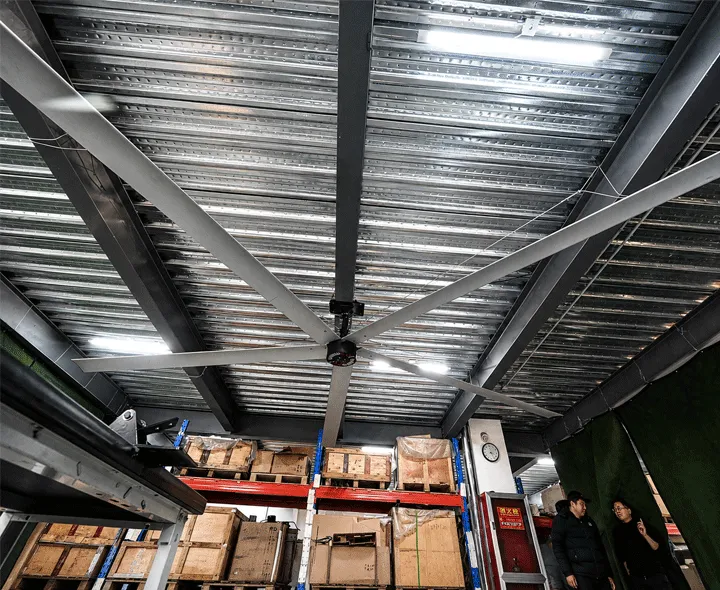
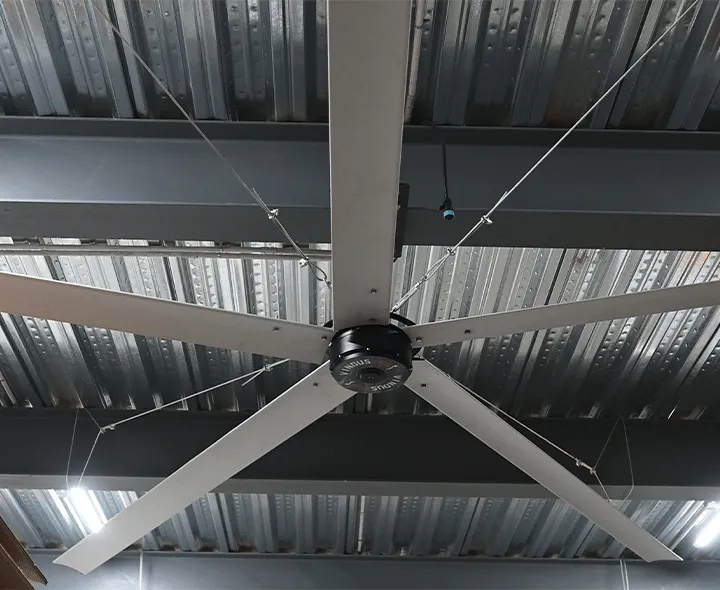
Choosing a large HVLS fan is a major investment for warehouses, factories, and commercial facilities. But comparing brands by diameter or price alone can lead to costly decisions. Buyers need to understand motor technology, blade design, power ratings, certifications, warranty coverage, and manufacturer support.
Hunter Industrial and COOL both offer direct-drive HVLS fan solutions for large buildings. Hunter provides the Titan, ECO, XP, and DDI product families, while COOL offers the five-blade PMSM P680, P730, and P780 series. This guide compares their published specifications, technologies, controls, and supplier services to help B2B buyers make an informed decision.

Hunter Industrial vs. COOL: Big HVLS Ceiling Fans for Commercial and Industrial Cooling
Artikelübersicht
- Why Compare Hunter Industrial and COOL HVLS Fans?
- What Are the Main Hunter Industrial and COOL Fan Models?
- How Do Hunter Industrial and COOL Specifications Compare?
- What Are the Differences in Motor and Drive Technology?
- How Do Blade Design and Fan Diameter Affect Performance?
- How Do Power Consumption, Airflow, and Certifications Compare?
- Which HVLS Fan Control System Offers Better Flexibility?
- What Should Buyers Check When Evaluating HVLS Manufacturers?
- How Do Warranty, Installation, and After-Sales Support Compare?
- How Can B2B Buyers Choose the Right HVLS Fan Supplier?
1. Why Compare Hunter Industrial and COOL HVLS Fans?
Hunter Industrial is an established industrial fan brand with a long history in fan manufacturing. Its current industrial product range includes several HVLS models, replacement parts, commercial fans, and air circulators. Its 2026 catalog presents Titan, ECO, XP, and DDI as its main industrial HVLS product families.
COOL takes a manufacturer and solution-provider approach to the same market. As a Sino-US joint venture specializing in industrial and commercial airflow systems, we develop PMSM direct-drive HVLS fans, intelligent control systems, and application-based solutions for warehouses, factories, logistics facilities, sports centers, and other large buildings.
Both brands offer direct-drive technology, but their product configurations, blade arrangements, published power ratings, control options, and warranty structures differ.
For buyers, the purpose of comparison is not simply to identify which brand has the largest fan. It is to determine which supplier offers the right technical configuration, documentation, project support, and long-term value.
2. What Are the Main Hunter Industrial and COOL Fan Models?
Understanding the product lineup is the first step in comparing manufacturers. Different models are designed for different building sizes, ceiling heights, and operating requirements.
Hunter Industrial Product Families
According to the official Hunter Industrial 2026 Product Catalog, its main HVLS products include:
| Hunter Model |
Durchmesserbereich |
Anzahl der Klingen |
Product Positioning |
| Titan |
14–24 ft |
5 |
Premium industrial HVLS |
| ECO |
8–24 Fu? |
4 |
Economical wide-area airflow |
| XP |
7–14 ft |
3 |
Compact HVLS applications |
| DDI |
20 and 24 ft |
3 |
Large-area direct-drive airflow |
Titan is Hunter’s flagship industrial model, while ECO offers a broad diameter range. XP focuses on smaller installations, and DDI provides a simplified large-diameter configuration.
The different blade counts and product designs give buyers several configurations to consider.
COOL P-Series Product Families
COOL organizes its main PMSM direct-drive range into three five-blade series:
| COOL Model |
Durchmesserbereich |
Anzahl der Klingen |
Recommended Blade Height |
| P680 |
8–14 ft |
5 |
10–25 ft |
| P730 |
16–18 ft |
5 |
20–33 ft |
| P780 |
20–24 Fu? |
5 |
20–33 ft |
The P680 is intended for medium-size commercial and industrial areas. The P730 serves larger workshops, warehouses, and production facilities, while the P780 targets large industrial buildings and high-ceiling applications.
This product structure makes it easier for distributors, contractors, and project buyers to select equipment according to building requirements.
3. How Do Hunter Industrial and COOL Specifications Compare?
A model-by-model comparison provides a clearer view of the differences between the two brands.
The following table uses published maximum power figures and available product information. These figures are manufacturer specifications, not independent laboratory rankings.
Main HVLS Product Comparison
| Marke |
Modell |
Durchmesser |
Klingen |
Published Maximum Power |
| Hunter |
XP |
7–14 ft |
3 |
227–821 W |
| Hunter |
ECO |
8–24 Fu? |
4 |
486–1,124 W |
| Hunter |
Titan |
14–24 ft |
5 |
715–1,472 W |
| Hunter |
DDI |
20–24 Fu? |
3 |
482–558 W |
| COOL |
P680 |
8–14 ft |
5 |
100–290 W |
| COOL |
P730 |
16–18 ft |
5 |
450–460 W |
| COOL |
P780 |
20–24 Fu? |
5 |
560–950 W |
The product ranges overlap in several important areas. For example, the Hunter XP, ECO, and COOL P680 all cover smaller diameters. The Hunter Titan and ECO overlap with the P730 and P780 in larger installations.
However, maximum power alone does not establish which fan moves more air or offers better efficiency. Blade geometry, rotational speed, motor control, and tested airflow must also be considered.
Comparing Similar Diameters
Some useful model comparisons include:
- 8 ft: Hunter XP and ECO versus COOL P680-8.
- 14 ft: Hunter XP, ECO, and Titan versus COOL P680-14.
- 16–18 ft: Hunter Titan and ECO versus COOL P730.
- 20–24 ft: Hunter Titan, ECO, and DDI versus COOL P780.
For example, COOL lists the P780-20 at 560 W, while Hunter lists the Titan 20 at 1,020 W and the DDI 20 at 558 W.
This is a useful starting point for procurement research, but it is not enough to determine efficiency. Buyers should request airflow and power measurements under equivalent testing conditions before making a final decision.
4. What Are the Differences in Motor and Drive Technology?
Motor technology is one of the most important differences to investigate when comparing industrial fan manufacturers.
Both Hunter and COOL use direct-drive technology in their published HVLS product ranges. A direct-drive design connects the motor to the fan hub without a traditional reduction gearbox. This removes gearbox-related oil servicing and reduces the number of mechanical transmission components.
Hunter Industrial Direct-Drive Technology
Hunter’s 2026 catalog describes its direct-drive motor as a gearless design that operates without gearbox oil. The company highlights quiet operation, reduced maintenance requirements, reversible airflow, and long-term reliability.
The catalog uses the term Direct Drive Motor across its industrial HVLS range. Buyers should consult the individual motor datasheet when they need detailed information about the exact motor architecture.
COOL PMSM Direct-Drive Technology
COOL specifically identifies its P-Series motor as a Permanent Magnet Synchronous Motor (PMSM).
Our PMSM direct-drive design is developed around several objectives:
- Stable low-speed operation.
- High torque for large-diameter blades.
- Reduced mechanical transmission complexity.
- No traditional gearbox oil changes.
- Variable-speed airflow control.
- A lightweight and compact drive arrangement.
The P680, P730, and P780 all use this technology.
The P730 and P780 also feature an integrated floor-level HMI and a single ceiling-to-floor cable arrangement. This makes routine operation and inspection more accessible without requiring technicians to climb to the roof for normal control adjustments.
Important comparison: Direct drive and PMSM are not competing terms. PMSM describes the motor technology, while direct drive describes the transmission arrangement. A proper comparison should examine the motor datasheet, controller, rated torque, operating speed, and complete-system performance.
5. How Do Blade Design and Fan Diameter Affect Performance?
Blade count is a visible difference between Hunter and COOL product families, but more blades do not automatically mean better airflow.
The Hunter Titan uses five 6005A structural-grade aluminum blades. ECO uses four structural-grade aluminum blades, while XP and DDI use three-blade configurations according to the 2026 catalog.
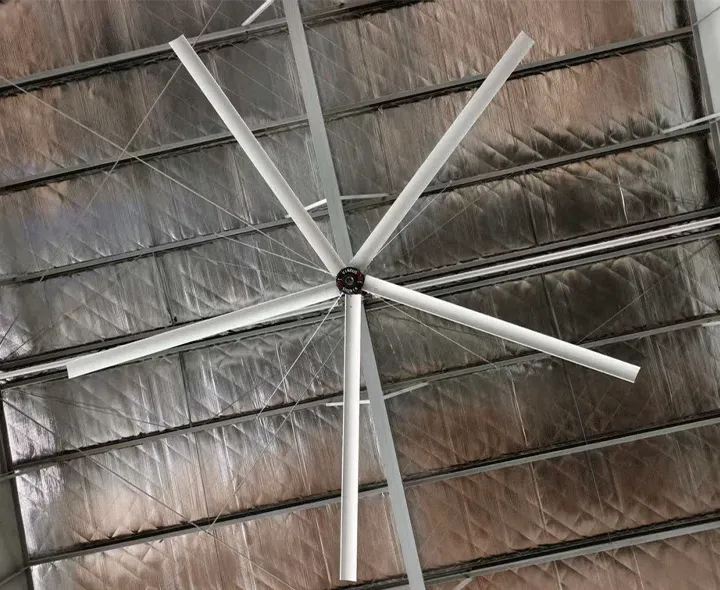
COOL uses five anodized aluminum blades across the P680, P730, and P780 series.
What Should Buyers Evaluate?
| Evaluation Factor |
Warum es wichtig ist |
| Blade count |
Determines the overall blade arrangement |
| Blade material |
Influences structural strength and weight |
| Blade profile |
Affects aerodynamic performance |
| Klingenabstand |
Influences airflow and motor loading |
| Blade connections |
Important for mechanical safety |
| Lüfterdurchmesser |
Influences the potential circulation area |
| Rotational speed |
Helps determine operating airflow conditions |
Hunter highlights its blade-holder mechanism and adjustable pitch on Titan. COOL emphasizes five-blade construction, safety retention links, and redundant safety provisions across critical components.
For large industrial projects, buyers should request blade drawings, material specifications, connection details, and relevant safety documentation.
The correct diameter must also match the actual ceiling height and mounting conditions. A 24 ft fan may be appropriate for a high warehouse but unsuitable for a building with limited clearance or extensive overhead equipment.

Hunter Industrial vs. COOL: Big HVLS Ceiling Fans for Commercial and Industrial Cooling
6. How Do Power Consumption, Airflow, and Certifications Compare?
Power consumption is an important purchasing factor, but it should never be considered in isolation.
A fan that uses less electricity may still be unsuitable if it does not provide the required airflow. Conversely, a larger fan with higher input power may serve a much wider area.
The most useful comparison combines:
- Input power at specified operating speeds.
- Airflow performance under a recognized test method.
- Fan Energy Index or another applicable efficiency rating.
- Operating noise.
- Installation conditions and accessories.
- Expected annual operating hours.
Certification Comparison
Hunter’s 2026 catalog states that Titan, ECO, and XP models carry the AMCA Certified Ratings Program seal. The certification coverage does not apply to the 7 ft XP model. DDI is not included in the catalog’s stated AMCA-certified model group.
The catalog also identifies ETL/Intertek certification to ANSI/UL 507 and CSA C22.2 No.113, along with CE and IEC 61800-3 information.
COOL product pages list UL/ULc certification and conformity with CE, EN, and IEC standards for the P-Series. Buyers should request the exact certificates and model-specific performance reports for the intended project.
These certifications serve different purposes. In particular, a safety certification should not be treated as proof of independently certified airflow performance.
A Better Way to Compare Efficiency
When evaluating two 20 ft fans, request:
- Measured airflow in CFM.
- Input power at the same operating point.
- CFEI or applicable efficiency data.
- Test standard and report number.
- Measurement conditions and included accessories.
This approach provides a more reliable comparison than marketing claims such as high efficiency or low energy consumption.
COOL is also transparent about an important purchasing point: model-specific airflow figures and quotations should be confirmed with the engineering team rather than estimated from diameter alone.
7. Which HVLS Fan Control System Offers Better Flexibility?
A good industrial fan system needs more than a motor and blades. Controls determine how easily facility managers can adjust airflow, respond to temperature changes, and manage several units.
Hunter offers digital controllers, scheduling functions, and optional Building Management System integration through its available control accessories and BACnet Gateway. The exact functions depend on the selected configuration.
COOL offers FanBrain, an intelligent control system developed specifically for HVLS applications.
FanBrain Control Features
| Funktion |
COOL FanBrain |
| Display |
10.1-inch touchscreen |
| Centralized control |
Up to 10 fans |
| Speed adjustment |
Variable speed |
| Direction |
Vorw?rts und Rückw?rts |
| Scheduling |
Automatic start and stop |
| Temperature control |
Sensor-based operation |
| Group management |
Independent area control |
| Communication |
Modbus-RTU |
| BMS integration |
Supported |
FanBrain can automatically adjust fan operation according to temperature settings. With roof and floor sensors, it can also support automatic reverse operation when the preset temperature difference is reached.
For a factory with several work areas, this provides a way to manage airflow by zone rather than treating the entire building as one operating area.
Explore the FanBrain intelligent HVLS control system for more technical details.
8. What Should Buyers Check When Evaluating HVLS Manufacturers?
A product comparison is only part of the procurement process. The manufacturer behind the product also matters.
For distributors, importers, and engineering contractors, important questions include:
- Does the supplier have engineering and R&D capabilities?
- Can it provide technical drawings and installation documents?
- Does it support OEM or customized projects?
- Can it provide spare parts and replacement components?
- Does it have experience in international markets?
- Can it support product selection and project planning?
Hunter Industrial’s Supplier Strengths
Hunter Industrial offers a broad product ecosystem that includes HVLS fans, commercial fans, air circulators, replacement parts, installation resources, and technical support.
Its official resources also provide product-specific CAD files, installation manuals, specifications, and maintenance documentation. This can be valuable for contractors and facility teams planning complex installations.
COOL Manufacturer and OEM Capabilities
COOL operates as a Sino-US joint venture manufacturer and solution provider, with manufacturing, assembly, and R&D facilities in Qingdao, China and Florida, USA.
Our international business covers more than 20 countries and regions. We work with distributors, HVAC contractors, warehouse operators, manufacturing companies, and other B2B customers.
Our OEM capabilities allow us to work with partners on product development, engineering requirements, and manufacturing resources.
For buyers interested in long-term supplier relationships, explore our OEM HVLS fan manufacturing services.
The right manufacturer is not necessarily the one with the longest product list. It is the one that can consistently meet the technical, commercial, and service requirements of your project.

Hunter Industrial vs. COOL: Big HVLS Ceiling Fans for Commercial and Industrial Cooling
9. How Do Warranty, Installation, and After-Sales Support Compare?
Warranty terms can have a major impact on the total cost of ownership. However, buyers should compare more than the number of years printed in a product brochure.
Hunter’s official FAQ identifies a Limited Lifetime Warranty for Titan, ECO, and XP. The DDI has separate warranty information in its 2026 catalog, including a five-year warranty reference for airfoils.
COOL publishes a three-year warranty covering defective components or parts that cause the fan to operate improperly. Extended warranty options may also be available for selected models.
Warranty Comparison
| Item |
J?ger Industrie |
COOL |
| Titan |
Limited Lifetime Warranty |
— |
| ECO |
Limited Lifetime Warranty |
— |
| XP |
Limited Lifetime Warranty |
— |
| DDI |
Separate five-year warranty reference |
— |
| P680 |
— |
3 years |
| P730 |
— |
3 years |
| P780 |
— |
3 years |
| Coverage details |
Refer to model-specific terms |
Defective components causing improper operation |
These warranty descriptions are not directly equivalent. Buyers should obtain the complete written terms and confirm component coverage, labor, exclusions, registration requirements, and shipping arrangements.
Installation support also deserves attention. Hunter provides professional installation and maintenance resources. COOL supports product selection and technical coordination through its engineering and service teams.
Before placing an order, ask both suppliers about installation guidance, commissioning, troubleshooting, replacement parts, and response times.
You can review COOL’s HVLS fan product warranty before requesting a quotation.
10. How Can B2B Buyers Choose the Right HVLS Fan Supplier?
There is no single brand that is automatically best for every project. A suitable choice depends on the building, application, electrical supply, performance requirements, budget, and local service arrangements.
For example, a buyer who prioritizes AMCA-certified performance data may give additional weight to Hunter Titan, ECO, or XP. A buyer who wants a five-blade PMSM product range with floor-level HMI operation and FanBrain centralized controls may find COOL worth evaluating.
Which COOL Model Should You Consider?
| Project Requirement |
Suggested COOL Model |
| Medium-size workshop |
P680 |
| Small logistics or commercial area |
P680 |
| Medium-to-large warehouse |
P730 |
| Manufacturing facility with 20–33 ft blade height |
P730 |
| Large industrial warehouse |
P780 |
| Large distribution center |
P780 |
These are initial product-screening suggestions, not final engineering selections.
A Practical B2B Procurement Checklist
Before choosing a supplier, request:
- Complete model specifications.
- Motor and controller datasheets.
- Blade material and structural details.
- Measured airflow and power reports.
- Applicable certification documents.
- Fan layout and mounting recommendations.
- Warranty terms and spare-parts information.
- Delivery schedule and commercial quotation.
At COOL Fans, we understand that different customers have different purchasing priorities. A distributor may need stable supply and OEM support, while an HVAC contractor may focus on installation drawings, system integration, and technical documentation.
Our team works with international B2B buyers to review building dimensions, ceiling height, operating conditions, and project requirements before recommending a suitable configuration.
If you are comparing Hunter Industrial with COOL for an upcoming project, send us your building drawings or basic project information. We can help you evaluate the P680, P730, and P780 product families and prepare a solution based on your actual requirements.
H?ufig gestellte Fragen
1. Is COOL better than Hunter Industrial for large warehouses?
Both manufacturers offer direct-drive HVLS products. Hunter provides a broad product range and AMCA-certified Titan, ECO, and XP models under its 2026 catalog. COOL offers five-blade PMSM direct-drive models, floor-level HMI features on P730 and P780, and FanBrain controls. The better choice depends on project requirements and verified performance data.
2. What is the difference between Hunter Titan and COOL P780?
Both models offer 20 ft and 24 ft configurations. Hunter Titan uses five structural-grade aluminum blades and a direct-drive motor. COOL P780 uses five anodized aluminum blades and a PMSM direct-drive motor. Their published maximum power ratings differ, so buyers should compare measured airflow and input power under equivalent conditions.
3. Are PMSM direct-drive HVLS fans more efficient?
PMSM direct-drive technology can reduce mechanical transmission losses by eliminating a traditional gearbox. However, actual system efficiency depends on motor design, controller performance, blade aerodynamics, and operating conditions. Buyers should request measured airflow and power data.
4. Does Hunter Industrial offer more warranty coverage than COOL?
Hunter lists a Limited Lifetime Warranty for Titan, ECO, and XP, while COOL publishes a three-year parts warranty for its P-Series. However, warranty coverage varies by component and model. Review the complete terms before comparing the two offers.
5. Can COOL provide OEM HVLS fans for distributors?
Yes. COOL provides OEM manufacturing and engineering support for business partners. Buyers can discuss product development, manufacturing requirements, technical configurations, and cooperation arrangements with the team.
6. Can FanBrain integrate with a building management system?
Yes. FanBrain supports Modbus-RTU communication and BMS integration. It also supports centralized control, temperature-based operation, scheduling, and independent fan groups.
Die wichtigsten Erkenntnisse
- Hunter Industrial and COOL both offer direct-drive HVLS fan solutions for commercial and industrial applications.
- Hunter Titan, ECO, XP, and DDI differ in blade count, diameter, power ratings, and warranty arrangements.
- COOL P680, P730, and P780 use five-blade PMSM direct-drive configurations.
- Power consumption alone does not determine efficiency. Compare measured airflow and input power using equivalent test methods.
- Certifications matter. Check the exact model and the scope of each certification.
- Control systems affect operating flexibility. FanBrain supports centralized control of up to 10 fans, temperature-based operation, and Modbus-RTU.
- Warranty terms require careful review. Compare component coverage, labor, exclusions, and service conditions.
- Manufacturer support is part of the investment. Engineering, OEM services, spare parts, and technical documentation matter.
- The right fan depends on the project. Building dimensions, ceiling height, electrical supply, and application should guide the final selection.
Planning a new HVLS fan project or looking for an alternative industrial fan manufacturer?
Contact COOL Fans to discuss your project, compare suitable product configurations, and request a quotation. Our team can help you evaluate the technical and commercial requirements of your next warehouse, factory, logistics, or commercial airflow project.