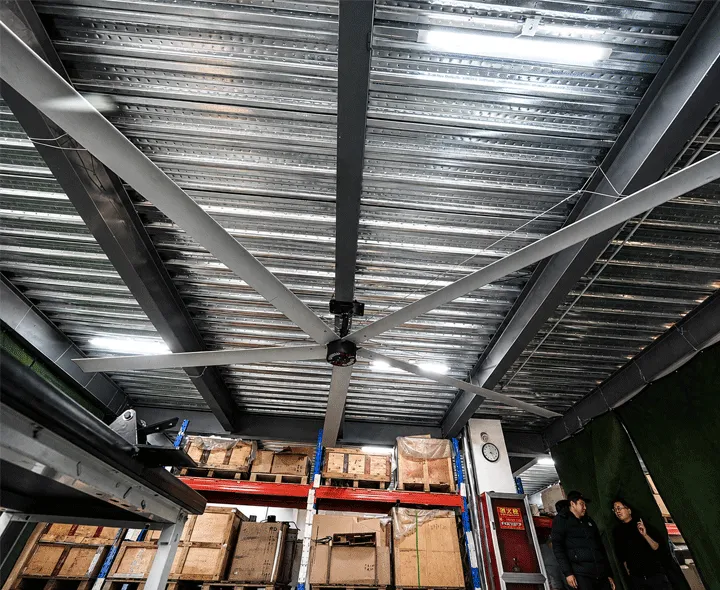
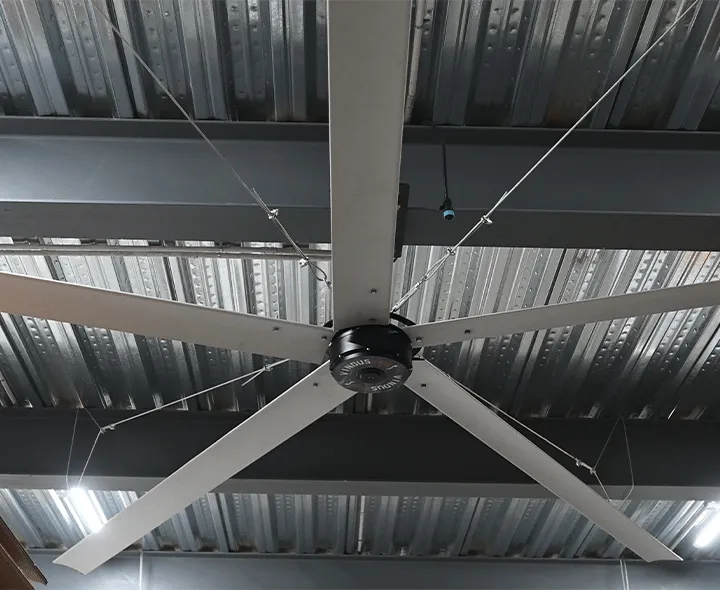
Hot spots in summer. Cold floors in winter. Stale, still air year-round. These problems drain energy and slow work. ?A properly sized Industrieller Deckenventilator—specifically an HVLS-Ventilator—to destratify warm air, boost Luftstrom, and cut HVAC runtime.
High-efficiency industrial ceiling fans?(often HVLS-Deckenventilator?systems) use wide blades turning slowly to move large volumes of air across big spaces. By destratifying warme Luft?in winter and improving Luftbewegung?in summer, these Industrieventilatoren?improve comfort and Energie sparen?use. Correct sizing, smart controls, and safe Deckenventilatorinstallation?deliver reliable savings in factories, warehouses, gyms, and other Industriefl?chen.
What is an industrial ceiling fan and how does it work?
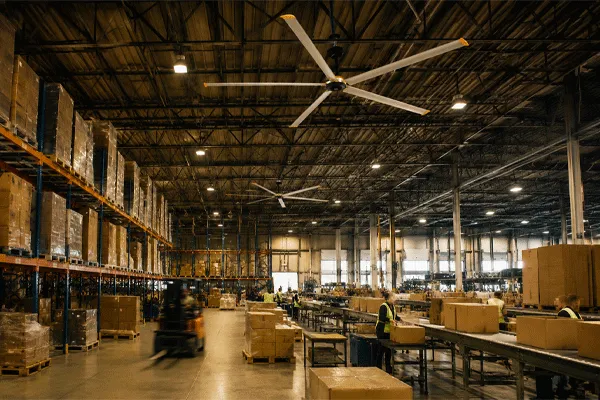
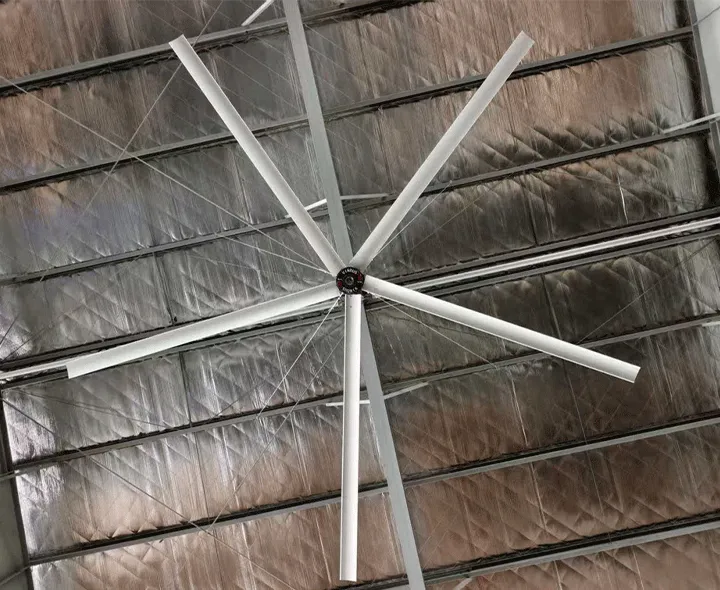
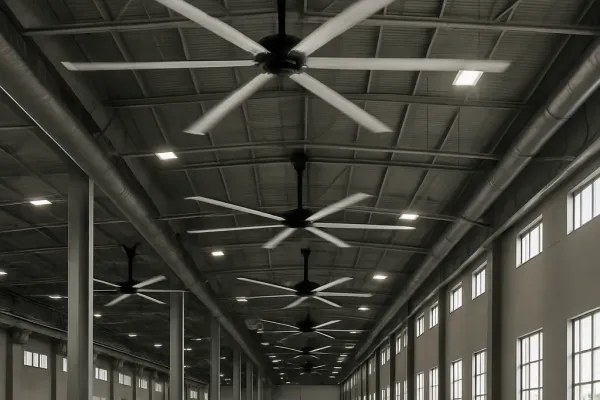
Ein Industrieller Deckenventilator?is a large-diameter, low-speed machine that sweeps gro?e Luftmengen?with minimal power. The wide airfoil blades and efficient Motor?generate steady Luftstrom?at low tip speeds, spreading comfort across large areas?without drafts. These “Lüfter mit hohem Volumen und niedriger Geschwindigkeit” are designed for large?rooms with hohe Decken?and heavy use.
In our commissioning visits, an Ingenieur?verifies mounting height, blade clearance, and industrial overhead?structure. The Lüftersystem?pushes a gentle column of air down, then outward along the floor, returning upward along the walls. This loop mixes warme Luft?trapped at the Decke, reducing temperature differences (destratification) so HVAC doesn’t work as hard. That improved air circulation?is what Ventilatoren sind konstruiert?to deliver for optimale Leistung.
Learn more about product families: our M650 series HVLS ceiling fans?Und kommerzielle Deckenventilatoren?for varied Fan-Optionen.
?What is an industrial ceiling fan and how does it work?
Why choose HVLS fan technology for industrial and commercial spaces?
HVLS-Ventilatoren sind gebaut?zu bewegen gro?e Mengen Luft?quietly and efficiently. The large diameter and slow rotation create a broad “river” of air that raises evaporative cooling at skin level in warm months and returns warme Luft?to the floor in winter. Independent and industry sources consistently link HVLS with better comfort and lower bills. For example, ASHRAE?documents Entstratifizierung?savings and thermal comfort in large buildings, while DOE?sets performance expectations for Deckenventilator?Effizienz.
From sports courts to distribution hubs, industrial ceiling fans are designed?to work alongside HVAC—Fans helfen?the system by mixing air so it conditions less. That’s why Industrieventilatoren sind so konzipiert?with broader coverage than small Richtungsventilatoren: one big unit can move large?volumes of air with less Energieverbrauch.
See applications: Warehouse HVLS fans application guide?Und big commercial ceiling fans for commercial buildings.
How do ceiling fans improve airflow and air quality in warehouses and gyms?
In einem Lager?or gym, still zones form behind racks, bleachers, and equipment. A well-placed Deckenventilator?breaks that up, creating consistent Luftbewegung?Und Luftqualit?t?benefits: fewer stagnant pockets, less condensation on cool surfaces, and less stratification that causes complaints. In short, the ceiling fan provides?even comfort.
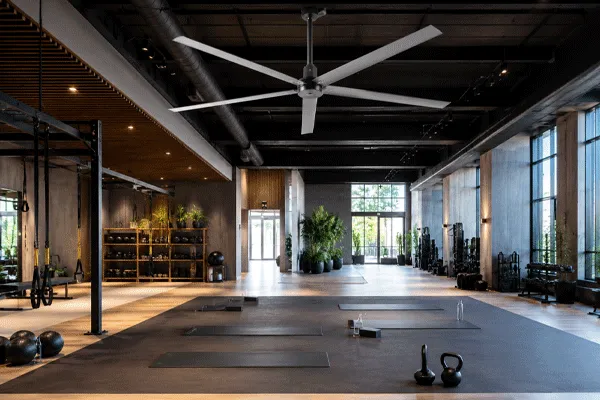
In fitness centers and Gewerbefl?chen, we often pair an HVLS-Ventilator?with make-up air so fans keep?the floor area fresh while HVAC handles temperature. This pairing is ideal for large?rooms because the Luftmenge?we’re mixing is huge, and fans are built to last?mit industrial grade?components.
Real-world fit: Kommerzielle Deckenventilatoren für Sportzentren?and a quiet fan for large?courts. Also review quiet HVLS fan guidance for commercial use.
Sizing guide: what size fan and how many for your square footage?
Durch die Wahl des rechter Lüfter?isn’t guesswork. We start with Quadratmeter, mounting height, obstructions, and target airspeed at occupant level (typically 2–4 fps for comfort). Many industrial ceiling fans?cover very gro?e offene?zones; others require mehrere Lüfter?for even coverage like warehouses?with aisles.
Rule-of-thumb table (illustrative):
| Space type |
Typical ceiling |
Recommended diameter |
Typical coverage per fan* |
| Fitness/Gym floor |
24–35 ft |
16–20 ft |
8,000–15,000 sq ft |
| Factories and warehouses |
30–45 ft |
18-24 Fu? |
12,000–30,000 sq ft |
| Aircraft/Logistics bay |
40–60 ft |
20–24 Fu? |
20,000–35,000+ sq ft |
*Coverage varies with obstacles, Decke?height, and target airspeed.
Industrial ceiling fans are typically?installed 10–15 ft below the roof structure with downrods to clear beams. If you have odd floorplates or mezzanines, a mix of one big unit and smaller langsam laufende Lüfter?may be the Lüfterl?sungen?Sie brauchen.
Explore models: M750 series HVLS fans for warehouse use?Und industrielle Deckenventilatoren für die Fertigung.
Ceiling fan installation and safety in industrial settings
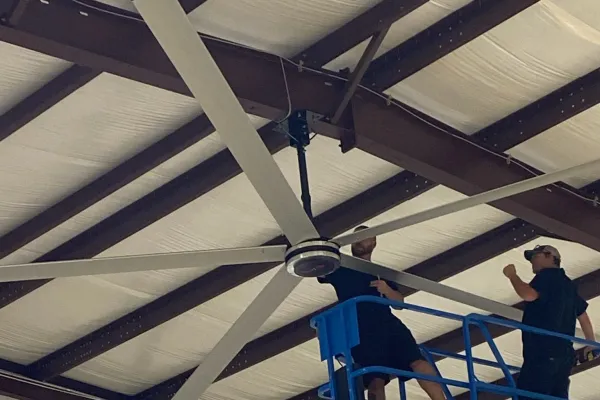
Sicher Deckenventilatorinstallation?matters. Structural checks, seismic bracing where required, and certified hardware ensure the unit is designed to handle?dynamic loads. Our Ingenieur?team verifies torque, electrical, and control integration so the Ventilator bietet?predictable performance.
A common request is “fans without?lights” for an industrial look?and minimal maintenance—perfect for Industrielle Umgebungen?where luminaires are handled separately. For corrosive or humid zones, consider coated blades or stainless hardware. Industrial ceiling fans include?safety cables, guy wires (as required), and UL/ETL listings.
Mounting options: see Verzinkter h?ngender Deckenventilator?for robust suspension kits.
?Ceiling fan installation and safety in industrial settings
Energy efficiency: how fans reduce energy costs with destratification
Mixing reduces delta-T between ceiling and floor, so heating systems cycle less. ASHRAE?materials and presentations report that destratification can save up to ~25% on heating and notable cooling savings by improving ventilation effectiveness—key for big buildings with hohe Decken. DOE?also outlines standards driving better Energieeffizienz?In Deckenventilator?Technologie.
In summer, fans reduce energy?by raising perceived cooling (≈2–4°C / up to ~hohe Lautst?rke?comfort effect) so thermostats can be set higher without comfort loss; heating months see warme Luft?brought down from the Decke, trimming gas or electric heat runtime. Manufacturers such as Fans mit gro?em Arsch?and others publish design notes showing reduced HVAC Energieverbrauch?when fans and AC run together.
Quick reference table: comfort & savings factors
| Saison |
What the fan does |
Practical effect |
Typical result |
| Cooling |
Breit Luftstrom?over occupants |
Higher evaporative cooling |
Higher setpoint, lower AC runtime |
| Heating |
Circulating air?to destratify |
Even temps from floor to Decke |
Less heat loss at roof, lower fuel use |
| Belüftung |
Mixes supply with room air |
Fewer stagnant zones |
Besser Arbeitsumgebung?Qualit?t |
Applications of industrial HVLS fans across sectors
Applications of industrial?air systems span manufacturing, logistics, sports, agriculture, and retail. Industrial HVLS fans?gro?e Luftmengen bewegen?gently, making them ideal for large?footprint rooms where ductwork cannot reach. They’re also great in Gewerbefl?chen?where noise must stay low.
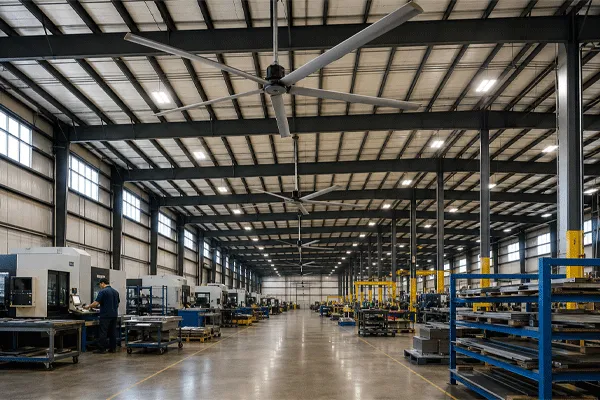
In einem Industrieanlage, we often supplement process ventilation. Lüfter sind?to team with heaters or DX units; even a single unit can cover a surprising Quadratmeter?when sized correctly. That starker Luftstrom?keeps workers comfortable and helps a safer work environment?by minimizing fog and condensation.
Sector pages: Big industrial fans for manufacturing, Lager HVLS-Ventilatoren, Und agriculture applications.

?hvls fans agriculture applications.
Controls and integration: getting the most from your fan system
Smart controls balance output with conditions. Temperature and humidity inputs, plus BAS integration, maximize efficiency. You can schedule setbacks, link to doors, and limit RPM near light debris. Many industrielle Deckenventilatoren?ship with forward/reverse and group control so mehrere Lüfter?behave as one Lüftersystem.
In practice, a Deckenventilator?and HVAC partnership works best. Raise the cooling setpoint by 2–4°F with kommerzielle Deckenventilatoren?running, or lower the heating setpoint after designed for large?destratification passes. Industrial ceiling fans move?air; HVAC adjusts temperature. Together, they deliver comfort and energy efficiency.
Integration notes and specs: HVLS fans manufacturer – About Us.
Spec checkpoints: blades, motor, safety, and noise
Look for efficient permanent-magnet Motor?options, robust blade-to-hub interfaces, vibration isolation, and AMCA/ETL/UL listings. Quiet operation matters in gro?e kommerzielle?interiors and education. Choose fans without lights?if photometrics are handled by architectural fixtures.
Industrial hvls?products should list coverage maps and clearances. The best pages show test data and certify that the Ventilatoren werden gebaut?for continuous duty. Some brands (for example, gro?e Arsch-Fans) publish helpful tools, though we always verify with on-site data.
Compare families by duty and finish: M750 series HVLS fans.
Case mini-study: manufacturing line with heat loads
A stamping plant struggled with heat stacking near presses. We modeled air paths and installed two 20-ft units with auto summer/winter modes. Result: more uniform temperatures and fewer operator complaints. Production leads reported steadier quality and a quieter floor than with many small Richtungsventilatoren.
Der ceiling fan helps?weiterverteilen warme Luft?during shoulder seasons, so the heating system cycles less. Operators said the Ventilator bietet?a “soft breeze” that’s comfortable even at stations close to the line. Maintenance noted minimal downtime—fans are built to last?and are easy to lint-wipe.
Related sector page: Industrielle Deckenventilatoren für die Fertigung.
Frequently asked questions
What makes these fans different from standard commercial ceiling fans?
Industrial ceiling fans are typically?much larger (16–24 ft) and turn slower to gro?e Luftmengen bewegen. Small kommerzielle Deckenventilatoren?are great for rooms, but gro?e industrielle Deckenventilatoren?cover bigger zones with fewer units and gentler airflow.
How do industrial ceiling fans include safety features for harsh environments?
Industrial ceiling fans include?redundant safety cables, guy wires, and rated mounts. They’re designed to handle?vibration and dust. HVLS-Ventilatoren sind gebaut?with sealed gearboxes or direct-drive fan technology?for durability in Industrielle Umgebungen.
Can fans reduce energy costs without changing the HVAC?
Yes. By destratifying in winter and raising comfort in summer, fans reduce energy?use. Many sites report lower bills and shorter HVAC runtimes, translating to reduce energy costs?over time. Sources like ASHRAE?outline these effects for hohe Effizienz?Betrieb.
Do industrial fans come with different options?
Yes—diameters, finishes, controls, and industrial fan options?like BAS integration. Many industrial ceiling fans?now ship “plug-and-play.” Choose the rechter Lüfter?für Ihre Quadratmeter?and mounting height; sometimes mehrere Lüfter?beat one oversized unit for optimale Leistung.
Will an HVLS ceiling fan work in spaces with obstructions?
Often, yes. We adjust mounting height and spacing to move large?volumes past racks and mezzanines. If needed, we supplement with Richtungsventilatoren. Der HVLS-Deckenventilator?handles the backbone mixing; spot fans finish edges.
What about lights, noise, and aesthetics?
Most industrial units are ordered without lights?for an industrial look, and sound levels are low at operating RPM. Lüfter sind?to blend in overhead structure; finishes support food, corrosion, or cleanroom goals.
How many amps do these fans draw?
It varies by diameter and control. Even large models draw only a fraction of HVAC power. Industrial ceiling fans move?air efficiently; that’s why they’re designed for large?zones where ducts struggle. DOE/NRDC materials also note evolving standards and DC drives for bigger units.
Which brands or categories are best?
Focus on performance data, certifications, and service—there are several solid manufacturers on the market, including well-known names (e.g., gro?e Arsch-Fans?for reference). More important is a correct design and safe Deckenventilatorinstallation?matched to your building.
Browse solution pages to match your environment: HVLS-Ventilatoren für Lagerhallen?Und commercial solutions.
Simple checklist before you buy
- Ceilingheight and obstacles measured?
- Structural attachment verified by an Ingenieur?
- Required Luftstromat occupant level defined?
- Controls planned for heating and cooling modes?
- Service access and lock-out procedures documented?
At-a-glance: quick spec table
| Spec topic |
What to look for |
Why it matters |
| Motor & drive |
Efficient PM or well-sealed gearbox |
Untere Energieverbrauch, high reliability |
| Klingen |
Airfoil with tested performance |
Smooth Luftbewegung, low noise |
| Kontrolliert |
BAS integration, temp/humidity logic |
Easier savings, maximize efficiency |
| Sicherheit |
Cables, guy wires, ETL/UL |
Compliance and a safer work environment |
| Garantie |
Long term with local support |
Proves fans are built to last |
Sources and further reading
- ASHRAEfeature on hangar destratification and energy performance.
- ASHRAE Philadelphia presentation: up to ~25% heating and ~30% cooling savings with HVLS (context-dependent).
- S. DOE overview of ceiling fan standards and definitions.
- NRDC brief on efficiency standards(context for large fans and DC drives).
- For product-level learning paths, see: Hersteller von HVLS-VentilatorenUnd HVLS-VENTILATOREN F?R LAGER.
Key takeaways (save this list)
- Industrieller DeckenventilatorSysteme gro?e Luftmengen bewegen?quietly—great for Industrieanlage
- Destratification returns warme Luftto the floor and trims heating fuel.
- In cooling season, setpoints rise while comfort stays high.
- Correct Gr??e Ventilator, placement, and controls matter more than brand.
- Combine with HVAC for comfort and energy efficiencyüber large industrial ceiling fans?use cases.
- Start with a walkthrough by an Ingenieur, then pick industrielle HVLS-Ventilatorenbuilt for duty.